
Salcombe C of E
Primary School
Writing

Writing @ Salcombe CE Primary
Intent
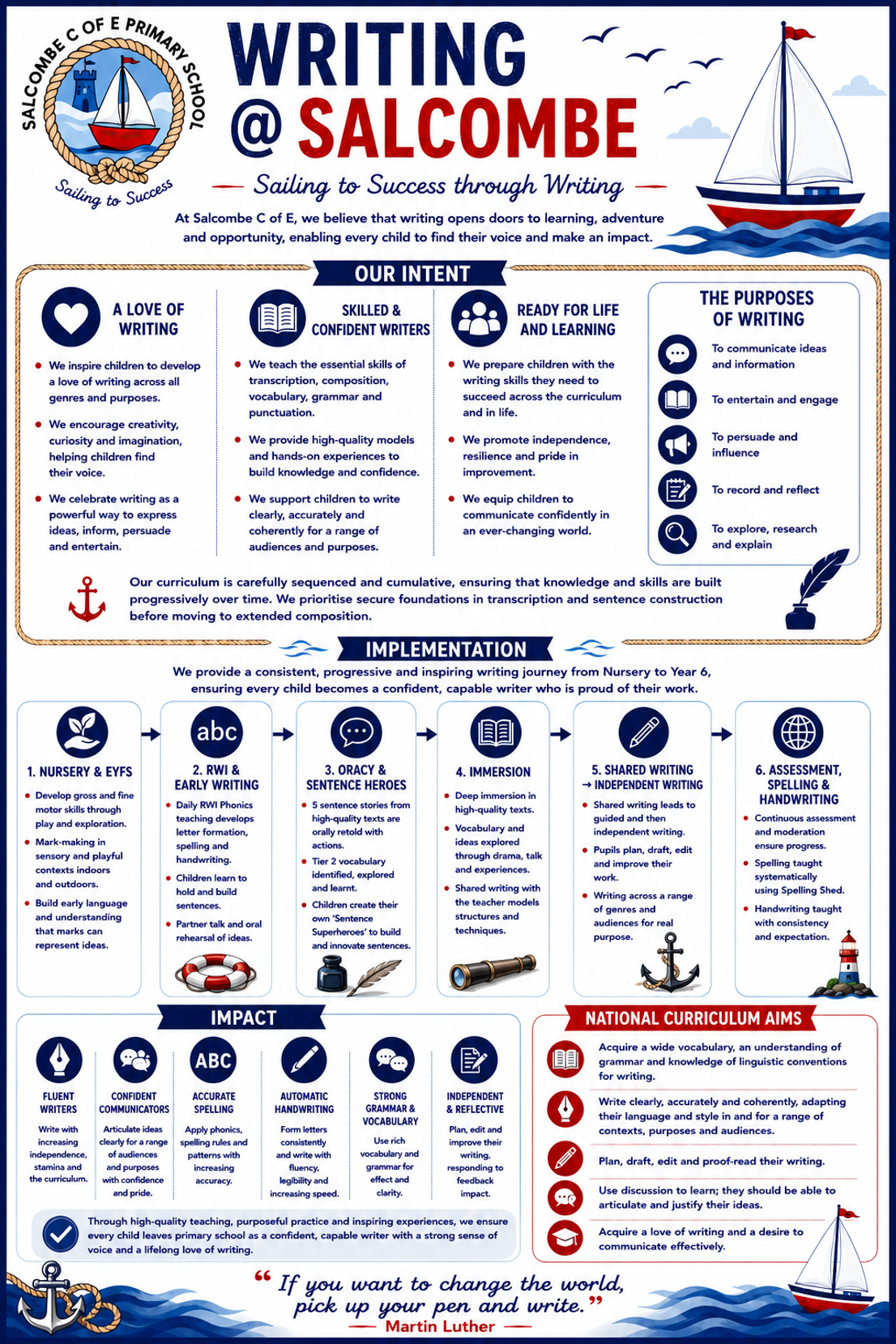
At Salcombe, our intent is to develop all pupils into fluent and confident writers who can communicate effectively across a range of contexts, audiences and purposes. In alignment with the Department for Education Writing Framework, our curriculum is underpinned by the understanding that writing is a complex cognitive process requiring the considered integration of transcription and composition. Our bespoke curriculum, that we have designed making links to our school context and in response to our children’s needs, enables pupils to write well-structured, engaging pieces drawing upon their ability to consider their toolkit for effect alongside the grammatical tools needed.
We intend for pupils to:
- Develop automaticity in transcriptional skills (handwriting and spelling), enabling them to write with fluency and accuracy
- Construct and manipulate sentences effectively, recognising the sentence as the fundamental unit of writing
- Articulate and organise ideas through talk, using spoken language to rehearse and refine thinking before writing
- Apply their knowledge of vocabulary, grammar and text structure to create meaningful and coherent pieces of writing
- Write with increasing independence, stamina and control across the curriculum
Our curriculum is designed to be carefully sequenced and cumulative, ensuring that knowledge and skills are built progressively over time. We prioritise secure foundations, recognising that pupils must master the basics of transcription and sentence construction before moving to extended composition.
We intend to provide:
- High-quality models of language through reading, recognising the reciprocal relationship between reading and writing
- Explicit instruction and guided practice, informed by subject-specific evidence and cognitive science
- Opportunities for purposeful writing, fostering motivation and engagement
- Adaptive teaching and early intervention, ensuring that all pupils, including those with additional needs, can succeed
Ultimately, we aim to ensure that every child leaves primary school able to write clearly, accurately, and effectively with a strong sense of authorial voice and an understanding and empowerment of how writing can be used to communicate ideas with pleasure and increasing ease.
Our pupils find their ‘voice’ in writing from a rich diet of inspiring, high-quality and diverse texts and extensive opportunities to share their ideas and orally rehearse before crafting their piece for a genuine audience, with a genuine purpose with genuine passion.
At Salcombe, our writing curriculum follows the objectives of the National Curriculum as a minimum. The aims of teaching writing, as outlined in the National Curriculum, are to ensure that all pupils:
• acquire a wide vocabulary, an understanding of grammar and knowledge of linguistic conventions for writing
• write clearly, accurately and coherently, adapting their language and style in and for a range of contexts, purposes and audiences
Implementation
In Nursery, pupils are provided with a wealth of resources, in a rich environment, to develop their gross and fine motor skills that precede their writing skills. Examples of such activities are: climbing, scooting digging, threading, squeezing, and manipulating malleable materials like dough. Mark-making is encouraged in a variety of sensory and playful contexts, including painting, drawing, making marks in sand or foam, and using large-scale movements such as ribbon dancing or water painting outdoors. These experiences help children develop hand-eye coordination, muscle strength, and control. The environment also promotes early communication and language, with adults modelling vocabulary and engaging in sustained interactions to give meaning to children’s marks. Through consistent exposure to these experiences, children begin to understand that marks can represent ideas, laying the groundwork for early writing development. Emergent writers can use various writing resources (chalk, paint, pens, pencils, water, and brushes) to practise making meaningful marks. Pupils can access these materials during independent learning times and use this to extend their play and ultimately their learning.
As children enter Reception, fine and gross motor activities continue through the Continuous Provision of the curriculum within an enabling environment; this is enhanced through the delivery of daily RWI Phonics sessions in which pupils learn individual letter formation, spelling and how to hold and build sentences. This consistent and systematic approach continues for children in Year 1 and Year 2 where children become confident in applying their phonics to writing, share ideas through partner work, think out loud and orally rehearse their sentences.
Running alongside the RWI hour of reading and Get Writing there is a bespoke writing curriculum that is centred around Oracy. The teacher creates 5 sentence stories derived from high-quality fiction or non-fiction texts for the children to orally retell whilst creating actions. From these stories, tier two vocabulary is identified, explored and learnt to support all children in accessing the text. Although children orally rehearse a five sentence text map, they are not expected to write at length yet as understand the importance of gaining and securing foundational skills before moving on to too much, too soon. To enable children to write at a phonologically appropriate level, pupils are supported to say, spell and write initial sounds, CVC words, CVVC words and two and three word phrases before moving onto constructing simple sentences about the core text they have been studying and have learnt. As the year progresses, children in year one will progress on from writing stand alone sentences and begin to retell the texts, writing at greater length and in time substitute ideas for their own. Children begin their metacognitive journey with writing by using the Sentence Superheroes toolkits that provide a tool to support children in constructing, editing and checking the content of their work.
Once children have progressed into Year 2, the writing curriculum becomes more detailed and structured; now that children have an understanding of basic grammar concepts, they are introduced to grammar toolkits and toolkits for effect. Coupled with a focus on real-life purpose and audience, children begin to become exposed to a range of different genres of writing and are engaged in writing for the community. The writing curriculum is designed to revisit genres in a progressive manner through our rolling programme and rotates around fiction, non-fiction and poetry to ensure a balanced coverage in our long-term planning. Our medium-term planning allows for units of work to be paced out and sequenced in a 3-4 weekly cycle which explores three phases of writing named, ‘immersion’, ‘shared writing’ and ‘independent writing’. These phases are interspersed with stand-alone grammar sessions, reactive grammar lessons and context-related grammar sessions to ensure the National Curriculum grammar expectations are being met as a minimum.
Spelling
At Salcombe, our intent is to ensure that all pupils become confident, accurate spellers who can apply their knowledge of spelling patterns and rules across the curriculum. We recognise that secure spelling underpins effective written communication and supports pupils in expressing their ideas clearly. We aim to develop pupils’ understanding of phonics, orthographic patterns and morphology, enabling them to make informed spelling choices. Pupils are encouraged to take pride in the accuracy of their work and to develop strategies for spelling unfamiliar words, fostering independence and resilience in their writing.
Spelling is taught explicitly and systematically from early reading through to upper key stages, following a clear progression through the Spelling Shed Programme. In the early stages, teaching builds on phonic knowledge, ensuring pupils can segment and encode words accurately. As pupils progress, teaching focusses on spelling rules, common exception words and patterns, including prefixes, suffixes and word families. Lessons include regular opportunities for retrieval practice, dictation and application in meaningful writing contexts to support long-term retention. Teachers model strategies such as breaking words into syllables, identifying root words and using known patterns to support spelling unfamiliar vocabulary. Targeted support is provided for pupils who need additional or adapted practice, while high expectations for accurate spelling are maintained across all subjects. Through consistent teaching and reinforcement, as well as through weekly homework, pupils develop fluency, confidence and independence in their spelling and are supported in addressing misspellings in a way that is appropriate to their stage (as detailed in the marking policy).
Handwriting
Our intent is to ensure that all pupils develop a fluent, legible and efficient handwriting style that supports their composition and overall writing development. We recognise that secure transcriptional skills are essential for freeing up cognitive capacity so that children can focus on the content and structure of their writing. We aim for pupils to develop correct letter formation from the outset, build automaticity in their handwriting and take pride in the presentation of their work.
Handwriting is taught as a crucial component of literacy, with high expectations for consistency and accuracy, enabling pupils to communicate effectively across the curriculum. Handwriting is taught explicitly and systematically from Reception onwards, following a clear progression. In the early stages, teaching focuses on correct posture, pencil grip and the formation of individual letters, with frequent opportunities for guided practice. Once secure, as pupils progress into Year 2 and Year 3, they are taught discretely to join letters fluently and develop a consistent, legible style. Teachers model handwriting regularly, using clear verbal and visual demonstrations and provide targeted feedback to address misconceptions. Application is embedded across the curriculum, ensuring high expectations for presentation are maintained in all subjects enabling pupils to write with increasing speed and ease. Additional support and intervention are provided for pupils who need further support enabling them to build fluency and confidence in their handwriting at a bespoke pace.
Impact
Teachers will use a range of formative and summative assessment in writing to assess the children’s understanding and what they need to do next. The design and delivery, along with assessment of pupils’ learning ensures that pupils will always know more, understand more and therefore do more. During the lesson, through live marking, questioning and tasks, teachers will check that the children have understood the focus of the learning; adults will assess the pupils’ achievements against the learning objective and feedback will be provided to support pupils in making progress.
In EYFS and Year 1, feedback is given at the point of learning and is focussed around the foundational aspects of Writing. In Year 2 and Year 3, the focus remains around the foundational skills and as the year progresses, Whole Class Feedback will be provided. This celebrates successful learning but importantly supports pupils in addressing any errors or misconceptions. The approach continues on into the upper school where editing and independence is promoted ensuring pupils are given sufficient time to respond to any feedback they have been given. At the end of each writing unit, pupils complete an independent piece of writing which is marked against the Trust’s English Writing Assessment Tool to which is linked to year group National Curriculum expectations. Teachers use this tool to inform future planning and provide high-leverage targets to pupils which support their next steps. Moderation across the school and Trust aims to ensure accuracy and consistency in teacher assessments and takes place termly.