Salcombe C of E
Primary School
Art

Art & Design @ Salcombe CE Primary
Intent
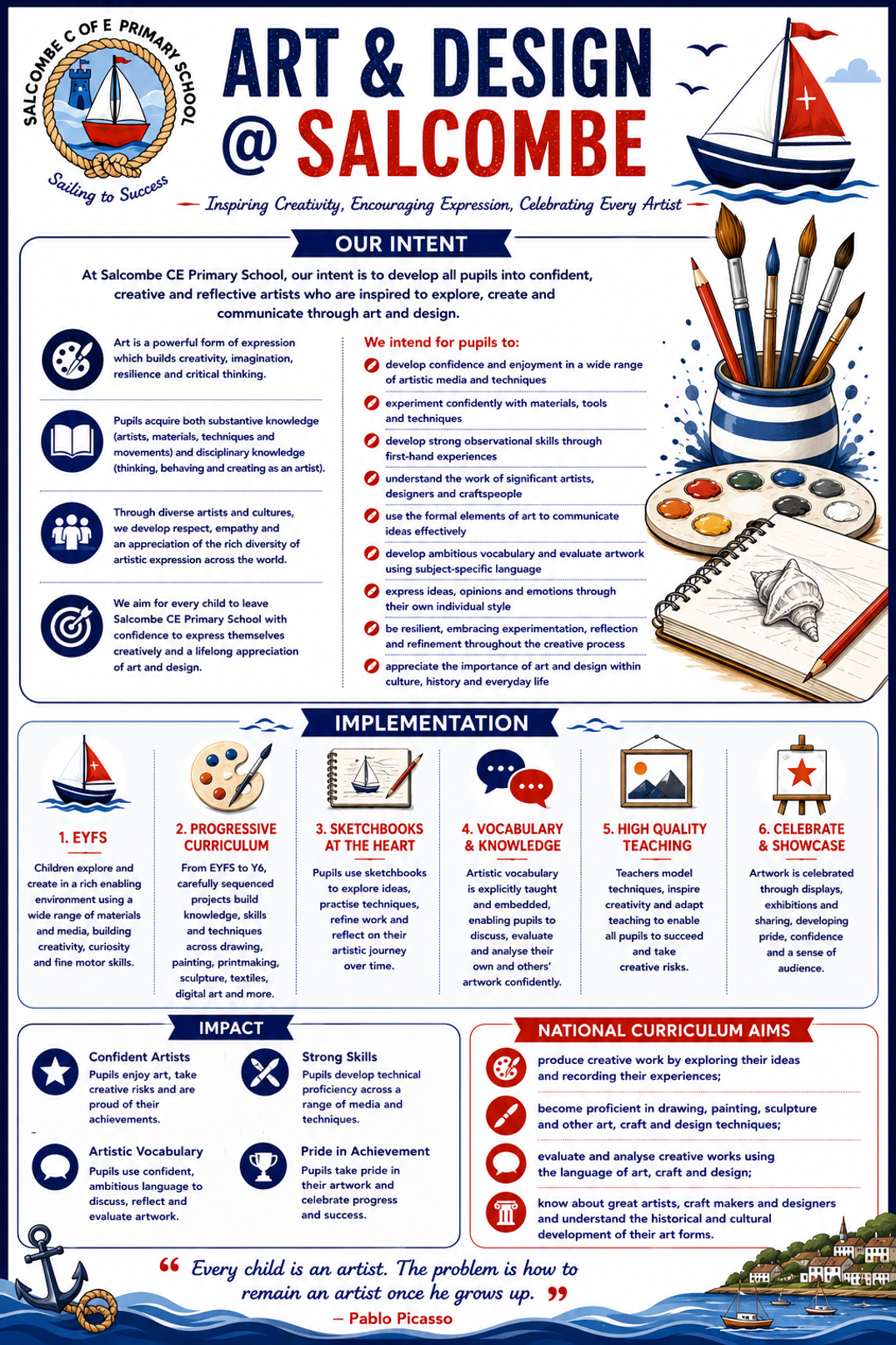
At Salcombe CE Primary School, our intent is to develop all pupils into confident, creative and reflective artists who are inspired to explore, create and communicate through art and design. In alignment with the National Curriculum, our curriculum is underpinned by the understanding that art is a powerful form of expression which enables children to develop creativity, imagination, resilience and critical thinking whilst making sense of the world around them. Through carefully sequenced learning, pupils acquire both the substantive knowledge (knowledge of artists, materials, techniques and artistic movements) and disciplinary knowledge (thinking, behaving and creating as an artist) needed to produce purposeful and meaningful artwork.
Our Art and Design curriculum follows the objectives of the National Curriculum as a minimum. The aims of teaching Art and Design, as outlined in the National Curriculum, are to ensure that all pupils:
- produce creative work by exploring their ideas and recording their experiences;
- become proficient in drawing, painting, sculpture and other art, craft and design techniques;
- evaluate and analyse creative works using the language of art, craft and design;
- know about great artists, craft makers and designers and understand the historical and cultural development of their art forms.
We believe that every child is an artist and that creativity should be nurtured, celebrated and developed throughout their primary education. Through high-quality teaching and carefully planned progression, pupils are encouraged to experiment, take creative risks and develop their own artistic voice whilst mastering an increasingly sophisticated range of artistic techniques. As well as through studying diverse artists, designers and craftspeople from different cultures, historical periods and communities, pupils develop respect, empathy and an appreciation of the rich diversity of artistic expression found across the world.
At Salcombe, we view art as a creative journey. Pupils are encouraged to explore, experiment, develop, create and reflect throughout every project. They understand that successful artwork rarely happens immediately and that mistakes, refinement and perseverance are valuable parts of the artistic process. Sketchbooks become personal working documents where ideas are collected, techniques are practised and creativity is nurtured, enabling pupils to see their artistic development over time.
We intend for pupils to:
- develop confidence and enjoyment in drawing, painting, sculpture, printmaking, textiles, collage, mixed media and digital art;
- experiment confidently with a wide range of materials, tools and techniques;
- develop strong observational skills through first-hand experiences and careful study of the world around them;
- understand the work of significant artists, designers, architects and craftspeople from a diverse range of cultures and historical periods;
- use the formal elements of art—including line, tone, shape, colour, texture, pattern, form and space—to communicate ideas effectively;
- develop ambitious artistic vocabulary and confidently evaluate artwork using appropriate subject-specific language;
- express their own ideas, opinions and emotions creatively whilst developing an increasingly individual artistic style;
- become resilient learners who embrace experimentation, reflection and refinement throughout the creative process;
- appreciate the importance of art and design within culture, history and everyday life.
Ultimately, we aim to ensure that every child leaves Salcombe CE Primary School with the confidence to express themselves creatively, the technical skills to communicate their ideas effectively and a lifelong appreciation of art and design. We aspire for our pupils to recognise creativity as an essential part of learning, wellbeing and cultural understanding, enabling them to flourish as imaginative, thoughtful and resilient individuals.
Implementation
In the Early Years, children begin their artistic journey through the ‘Expressive Arts and Design’ area of learning. Within a rich and enabling environment, pupils are encouraged to explore, investigate and create using a wide range of materials and media. Opportunities to paint, draw, print, model, construct and create are embedded throughout continuous provision, enabling children to develop confidence, imagination and fine motor control. Adults carefully model artistic vocabulary and encourage children to talk about their ideas, make creative choices and experiment freely with colour, texture, pattern, form and shape. These early experiences establish the foundations for artistic thinking whilst nurturing curiosity and creativity. This reflects the emphasis on exploring materials, colour, texture and meaningful mark making from the earliest stages.
As pupils move into Key Stage One, learning builds systematically upon these foundations through carefully sequenced projects that introduce pupils to an increasingly broad range of artistic techniques and materials. Children develop confidence in drawing, painting, printmaking and sculpture whilst learning how artists use the formal elements of art to communicate ideas. Teachers explicitly model practical skills before providing opportunities for pupils to experiment independently, encouraging them to refine their techniques and develop confidence through repeated practise.
Throughout Key Stage Two, pupils continue to revisit and refine artistic knowledge whilst developing increasing independence and technical control. They investigate a broad range of media including mixed media, printmaking, sculpture, digital art and three-dimensional construction, applying increasingly sophisticated techniques within their own creative work. This reflects the progressive development of artistic techniques and increasing mastery outlined within our curriculum.
Sketchbooks are central to our curriculum and travel with pupils throughout their artistic journey. They are valued as working documents rather than scrapbooks, providing a space where children collect inspiration, record observations, experiment with media, practise techniques and reflect upon their artistic development. Pupils are encouraged to revisit previous ideas, annotate their work and evaluate their progress, understanding that artistic development is a continuous process of exploration and refinement.
Vocabulary is explicitly planned and systematically revisited throughout every unit. Teachers introduce and model ambitious artistic vocabulary alongside practical demonstrations, enabling pupils to discuss artwork with increasing confidence and precision. Through regular opportunities for critique and discussion, pupils learn to evaluate both their own work and that of others thoughtfully and respectfully, using appropriate subject-specific language to justify artistic decisions.
Artwork is celebrated throughout the school and wider community through high-quality displays, exhibitions and shared celebrations. By giving pupils authentic audiences for their work, we foster pride, motivation and a sense of achievement whilst demonstrating the value we place upon creativity across the curriculum.
Adaptive teaching ensures all pupils access ambitious artistic experiences. Teachers provide carefully scaffolded demonstrations, visual prompts, targeted questioning and practical support whilst maintaining high expectations for every learner. Opportunities for greater depth encourage pupils to develop increasingly independent artistic decisions and sophisticated creative outcomes.
Impact
Teachers use a range of formative assessment strategies to evaluate pupils' artistic knowledge, practical skills and creative development. Observation, discussion, sketchbooks and practical outcomes enable teachers to identify misconceptions, celebrate creativity and provide responsive feedback that supports continual improvement.
Assessment values both the artistic process and the finished outcome. Throughout each project, teachers assess pupils' ability to experiment, develop ideas, refine techniques and communicate creatively whilst building increasingly secure substantive and disciplinary knowledge. Sketchbooks provide valuable evidence of artistic thinking, experimentation and progression, demonstrating how pupils develop confidence and technical skill over time.
At the end of each unit, pupils produce a final piece of artwork that showcases the knowledge, skills and techniques developed throughout the project. Alongside these outcomes, pupil discussion, retrieval activities and ongoing assessment provide teachers with a comprehensive understanding of each child's artistic development. Progress is measured through the development of practical skills, increasing confidence, creative independence and the ability to discuss and evaluate artwork using accurate artistic vocabulary.
As pupils progress through the curriculum, they become increasingly confident in selecting appropriate materials, applying artistic techniques and expressing their own creative ideas. They develop resilience, perseverance and a willingness to refine their work, recognising that artistic success is achieved through exploration, reflection and continuous improvement.
The impact of our curriculum is evident in pupils who are enthusiastic artists, embrace creativity with confidence and take pride in expressing themselves through a wide range of artistic media. They demonstrate curiosity about artists from different cultures and historical periods, appreciate the role of creativity within society and confidently discuss artwork using ambitious subject-specific vocabulary.
By embedding our Christian ethos and values, when pupils leave Salcombe CE Primary School, they possess a rich body of artistic knowledge, secure practical skills and the confidence to think and behave as artists. They leave equipped not only for the next stage of their education but also with a lifelong appreciation of creativity, culture and the important role that art and design play in enriching their own lives and the communities in which they live.