
Salcombe C of E
Primary School
Maths

Mathematics @ Salcombe Church of England Primary School
Intent
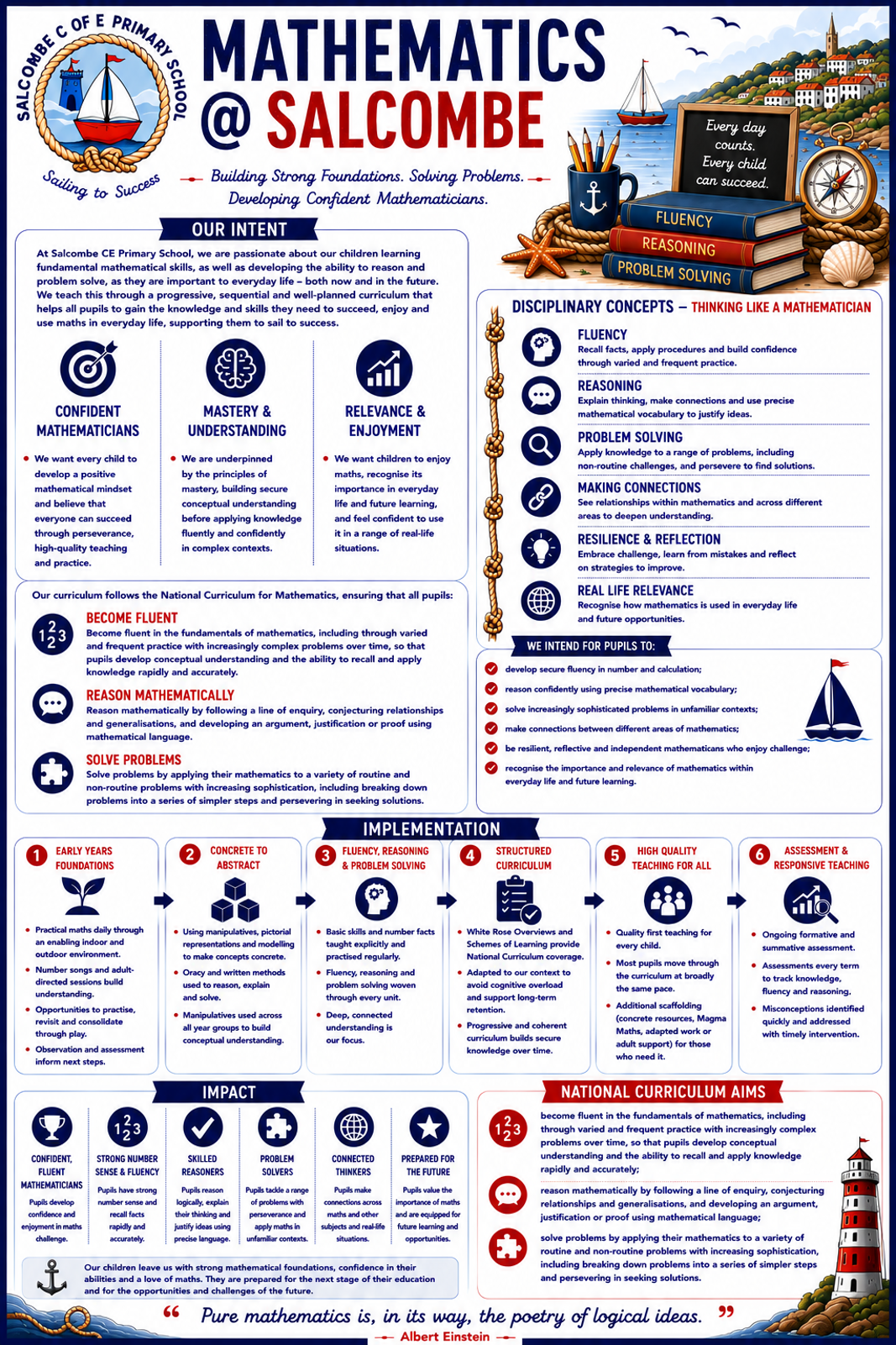
At Salcombe CE Primary School, we are passionate about our children learning fundamental mathematical skills, as well as developing the ability to reason and problem solve, as they are important to everyday life – both now and in the future. We teach this through a progressive, sequential and well-planned curriculum that helps all pupils to gain the knowledge and skills they need to succeed, enjoy and use maths in everyday life, supporting them to sail to success.
Serving a rural coastal community in Devon, we recognise that pupils arrive with a wide range of mathematical experiences and levels of confidence. Our ambition is for every child to develop a positive mathematical mindset, believing that everyone can achieve success through perseverance, high-quality teaching and carefully planned learning opportunities.
Our curriculum is underpinned by the principles of mastery, ensuring that pupils develop both substantive knowledge (mathematical facts, concepts and procedures) and disciplinary knowledge (thinking, reasoning and communicating as mathematicians). Through carefully sequenced learning, pupils build secure conceptual understanding before applying their knowledge fluently and confidently in increasingly complex contexts.
We cover the National Curriculum for Mathematics, which ensures that all pupils:
- become fluent in the fundamentals of mathematics, including through varied and frequent practice with increasingly complex problems over time, so that pupils develop conceptual understanding and the ability to recall and apply knowledge rapidly and accurately;
- reason mathematically by following a line of enquiry, conjecturing relationships and generalisations, and developing an argument, justification or proof using mathematical language;
- solve problems by applying their mathematics to a variety of routine and non-routine problems with increasing sophistication, including breaking down problems into a series of simpler steps and persevering in seeking solutions.
We intend for pupils to:
- develop secure fluency in number and calculation;
- reason confidently using precise mathematical vocabulary;
- solve increasingly sophisticated problems by applying their knowledge in unfamiliar contexts;
- make connections between different areas of mathematics;
- be resilient, reflective and independent mathematicians who enjoy challenge;
- recognise the importance and relevance of mathematics within everyday life and future learning.
Implementation
At Salcombe CE Primary School, we believe that all children can be successful in the study of mathematics. To achieve mastery, our expectation is that through quality first teaching, all our children will successfully access the learning. We expect most pupils to move through the programmes of study at broadly the same pace. However, for children who lack fluency, we provide opportunities to consolidate their understanding through additional scaffolding (concrete resources, Magma Maths, adapted work or adult support).
We understand the importance of basic skills in Maths and emphasise the need for children to become confident when solving calculation questions and using known facts efficiently. As well as this, we believe that it is extremely important that all children are taught explicitly how to reason mathematically and solve increasingly complex reasoning and problem-solving questions. Fluency, reasoning and problem solving are woven throughout every unit of learning ensuring pupils develop a deep and connected understanding of mathematics.
Children in the Early Years (Nursery and Reception classes) experience practical mathematics daily through an enabling environment, which supports continuous provision both indoors and outdoors. The rich outdoor environment supports children's mathematical language development, meaning that mathematical thinking is embedded naturally through play. Alongside this, number songs are an integral part of mathematics in the Early Years, building children's mathematical understanding through high levels of engagement. This provision is complemented by adult-directed Maths sessions which build children's knowledge and skills across number, numerical patterns and shape, space and measure. Children have endless opportunities to practise, revisit and consolidate skills while developing their mathematical curiosity. Careful observation and assessment are used to inform future planning.
From Early Years through to Year 6, children are taught explicit skills that they will be expected to use. Using carefully selected manipulatives, pictorial representations and modelling, teachers demonstrate how children can use both their oracy and written methods to reason, explain and answer questions. Manipulatives are used across all year groups to help children make abstract concepts concrete, developing conceptual understanding, reasoning skills and confidence through hands-on learning.
At Salcombe CE Primary School, we use a range of documents to support planning. For long-term planning, we use the White Rose Overviews and Schemes of Learning, ensuring full National Curriculum coverage. In order to avoid cognitive overload and support long-term retention, each year group has adapted the White Rose Schemes of Learning into carefully sequenced medium-term plans. These have been quality assured by the Maths Lead to ensure progression through small, manageable steps. Short-term planning follows our standardised lesson structure, including retrieval of previous learning, explicit vocabulary instruction, 'I do, We do, You do' modelling and opportunities for reflection at the end of each lesson. We also use Magma Maths as an online platform to consolidate, scaffold and extend learning.
Retrieval practice is a key feature of mathematics teaching at Salcombe. Daily review opportunities, White Rose Flashback activities and carefully planned questioning ensure that previously taught knowledge is revisited regularly, strengthening pupils' long-term memory and enabling them to make meaningful connections between mathematical concepts.
To ensure children are appropriately challenged, teachers provide a range of 'chilli' challenges (1, 2 and 3 as a minimum), with additional deepening questions to further extend learning. A variety of questions are used across different contexts, including fluency, reasoning and problem-solving tasks. These challenges allow children to demonstrate their understanding in different ways. Teachers carefully consider each child's needs and provide appropriate scaffolds to ensure that ambitious mathematical learning remains accessible to all. Adaptive teaching ensures that support and challenge are responsive to pupils' needs without lowering expectations.
Times tables are practised regularly in the classroom and for homework from Year 2 onwards. All pupils from Year 2 have access to Times Tables Rock Stars for use both at home and in school. Our aim is for every child to become secure in multiplication facts by the end of Year 4, as outlined within the Salcombe Multiplication Progression Strategy. Regular competitions and celebrations motivate pupils to develop fluency, while younger children access NumBots to strengthen early number sense through engaging games. Weekly celebration assemblies recognise pupils' achievements and encourage positive attitudes towards mathematics.
Impact
Teachers use a range of formative and summative assessment strategies to assess pupils' conceptual understanding, fluency, reasoning and problem-solving skills throughout the mathematics curriculum. During lessons, live assessment, questioning, observation and responsive feedback enable teachers to identify misconceptions quickly and adapt teaching accordingly. Assessment is used diagnostically to inform next steps, ensuring that all pupils continue to make strong progress through the curriculum.
As pupils progress through the school, they develop increasing fluency in number, confidence in applying efficient calculation strategies and the ability to reason mathematically using precise vocabulary. Through carefully sequenced learning and regular opportunities to explain their thinking, pupils become increasingly confident mathematicians who are able to apply their knowledge across a wide range of mathematical contexts.
Retrieval practice forms an integral part of our mathematics curriculum. Throughout the year, teachers revisit previously taught concepts using White Rose Flashback materials alongside the review section of every lesson. These regular opportunities to retrieve and apply prior learning strengthen long-term memory, improve retention and enable pupils to make increasingly sophisticated connections across different areas of mathematics.
At the end of each full term, pupils complete standardised assessments. These results, alongside classwork, ongoing formative assessment and professional dialogue, enable teachers to evaluate progress against National Curriculum expectations and identify any misconceptions or gaps in learning. This information is used to adapt future planning, provide timely intervention where required and ensure that all pupils continue to move forward with confidence.
The impact of our curriculum is evident in pupils who demonstrate positive attitudes towards mathematics, show resilience when faced with challenge and confidently explain, justify and apply their mathematical thinking. They understand that mistakes are an important part of learning and approach unfamiliar problems with increasing independence and perseverance.
By the time pupils leave Salcombe CE Primary School, they have developed secure mathematical knowledge, fluency in number, confidence in reasoning and the ability to solve problems independently. They leave as capable, resilient and reflective mathematicians who are well prepared for the next stage of their education and equipped with the mathematical understanding needed to thrive in everyday life.