Salcombe C of E
Primary School
Religious Education

Religious Education @ Salcombe Church of England Primary School
Intent
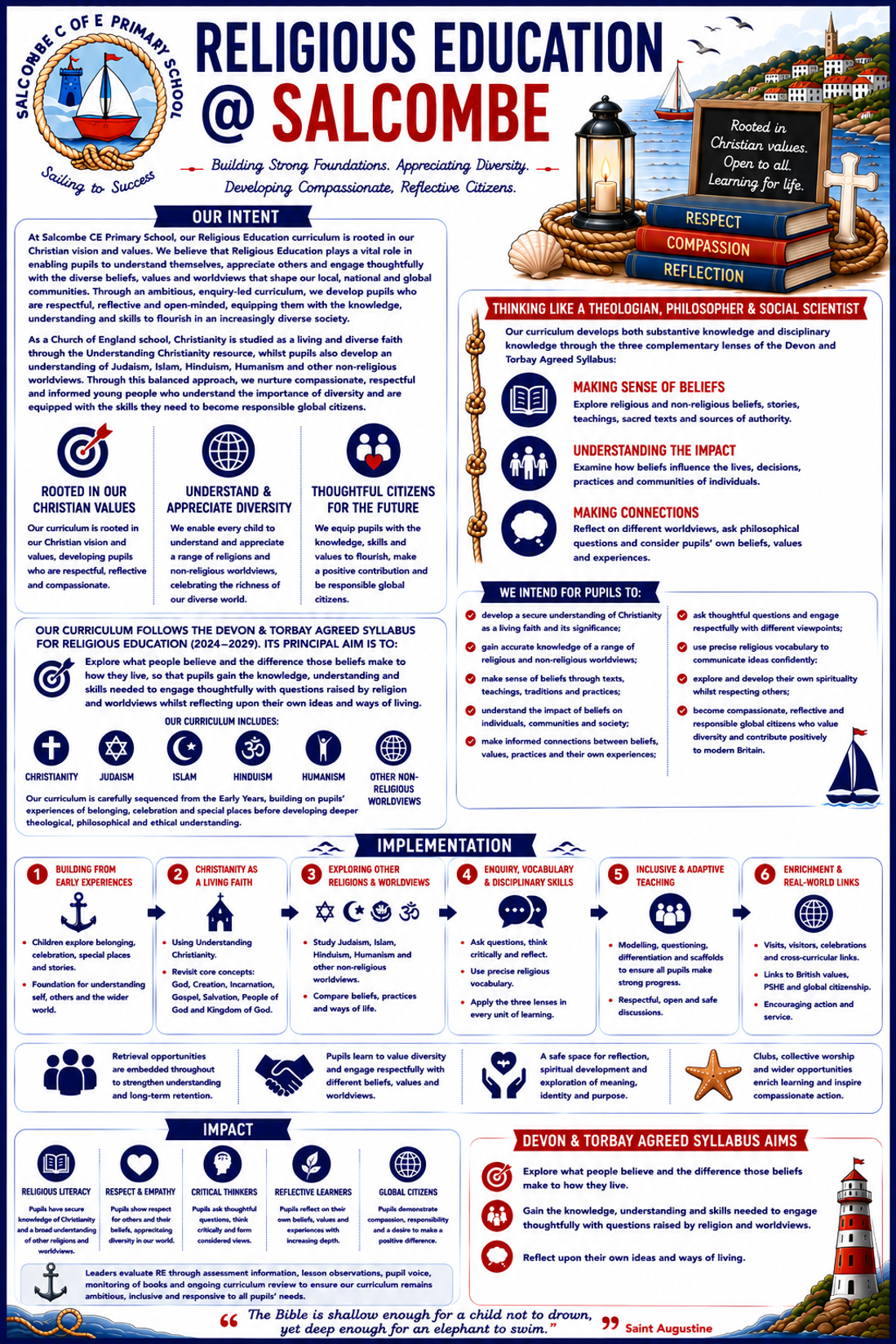
At Salcombe CE Primary School, our Religious Education curriculum is rooted in our Christian vision and values. We believe that Religious Education plays a vital role in enabling pupils to understand themselves, appreciate others and engage thoughtfully with the diverse beliefs, values and worldviews that shape our local, national and global communities. Through an ambitious, enquiry-led curriculum, we develop pupils who are respectful, reflective and open-minded, equipping them with the knowledge, understanding and skills to flourish in an increasingly diverse society.
Serving a rural coastal community in South Devon, we recognise that pupils may have varied experiences and understanding of religion and belief. Our objective is to enable every child, regardless of their starting point, to develop a secure understanding of Christianity, other religions and non-religious worldviews through a carefully sequenced and progressive curriculum. We believe that Religious Education should enable children not only to acquire knowledge, but also to explore questions of meaning, identity and purpose, develop their own spirituality and reflect upon their own beliefs whilst showing respect for the beliefs and values of others.
As a Church of England school, Christianity is studied as a living and diverse faith through the Understanding Christianity resource, whilst pupils also develop an understanding of Judaism, Islam, Hinduism, Humanism and other non-religious worldviews. Through this balanced approach, we nurture compassionate, respectful and informed young people who understand the importance of diversity and are equipped with the skills they need to become responsible global citizens.
Our curriculum follows the Devon and Torbay Agreed Syllabus for Religious Education (2024–2029), whose principal aim is to explore what people believe and the difference those beliefs make to how they live, so that pupils gain the knowledge, understanding and skills needed to engage thoughtfully with questions raised by religion and worldviews whilst reflecting upon their own ideas and ways of living.
Our curriculum develops both substantive knowledge (knowing about beliefs, teachings, sacred texts, practices, traditions and ways of living within different religions and worldviews) and disciplinary knowledge through the three complementary lenses identified within the Devon and Torbay Agreed Syllabus:
- Making sense of beliefs by exploring religious and non-religious beliefs, stories, teachings, sacred texts and sources of authority.
- Understanding the impact by examining how beliefs influence the lives, decisions, practices and communities of individuals.
- Making connections by reflecting on different worldviews, asking philosophical questions and considering pupils' own beliefs, values and experiences.
These three strands underpin every unit of learning, enabling pupils to think increasingly as theologians, philosophers and social scientists whilst developing secure religious literacy.
We intend for pupils to:
- develop a secure understanding of Christianity as a living faith and appreciate its significance within Britain and the wider world;
- gain accurate knowledge and understanding of a range of religious and non-religious worldviews;
- make sense of beliefs by exploring sacred texts, teachings, traditions and practices;
- understand the impact that beliefs and worldviews have on individuals, communities and society;
- make informed connections between different beliefs, values, practices and their own experiences;
- ask thoughtful questions, think critically and engage respectfully with different viewpoints;
- use increasingly precise religious vocabulary to communicate ideas confidently;
- explore and develop their own spirituality whilst respecting the beliefs and values of others;
- become compassionate, reflective and responsible global citizens who value diversity and contribute positively to modern Britain.
Our curriculum has been carefully sequenced to build progressively from children's own experiences of belonging, celebration and special places in the Early Years before extending their understanding through increasingly sophisticated theological, philosophical and ethical enquiry. Through the Understanding Christianity resource, and the NATRE scheme of work, pupils revisit the core concepts of God, Creation, Incarnation, Gospel, Salvation, People of God and Kingdom of God, developing increasingly deep theological understanding. Alongside this, pupils progressively explore Judaism, Islam, Hinduism, Humanism and other non-religious worldviews, enabling them to compare beliefs, identify similarities and differences and develop increasingly sophisticated religious literacy. Carefully sequenced enquiry questions encourage pupils to revisit prior learning, deepen understanding and make meaningful connections between beliefs, practices and lived experiences.
Ultimately, we aim for every child to leave Salcombe CE Primary School with a secure understanding of Christianity, a broad knowledge of other religions and non-religious worldviews, and the confidence to engage respectfully with diversity. We aspire for our pupils to become thoughtful, compassionate and reflective individuals who value difference, think critically, explore life's big questions and contribute positively to an increasingly diverse society.
Implementation
Religious Education is taught through carefully sequenced enquiry units which follow the Devon and Torbay Agreed Syllabus (2024–2029) and are enriched through the Understanding Christianity resource. Learning is organised through both systematic studies of individual religions and thematic enquiries, enabling pupils to develop increasingly secure knowledge of Christianity and other religious and non-religious worldviews whilst making meaningful comparisons across beliefs, practices and values.
Every unit of learning is structured around the three key disciplinary elements of the Devon and Torbay Agreed Syllabus:
Making Sense of Beliefs
Pupils explore religious and non-religious beliefs, sacred texts, stories, teachings and traditions. They investigate key concepts, develop secure religious vocabulary and learn how beliefs are expressed, interpreted and understood by different individuals and communities.
Understanding the Impact
Children examine how beliefs influence the everyday lives of believers, shaping decisions, relationships, worship, celebrations, moral choices and community life. Through this, pupils develop an understanding that beliefs have practical significance and continue to influence people throughout the world today.
Making Connections
Pupils are encouraged to reflect on and evaluate what they have learned, making thoughtful connections between different religions and worldviews, their own experiences and wider philosophical questions. They develop the confidence to express personal views respectfully whilst recognising and valuing the beliefs of others.
Throughout each sequence of learning, teachers provide opportunities for pupils to:
- explore beliefs through stories, sacred texts and religious teachings;
- investigate artefacts, symbols and places of worship;
- meet visitors and learn from members of faith communities where appropriate;
- use drama, role play and creative activities to deepen understanding;
- engage in high-quality discussion and respectful debate;
- explore philosophical and ethical questions;
- reflect upon their own beliefs, values and experiences.
The Understanding Christianity resource provides a coherent theological framework through which pupils revisit the concepts of God, Creation, Incarnation, Gospel, Salvation, People of God and Kingdom of God throughout their primary education. This progressive approach enables pupils to deepen their understanding of the Christian narrative whilst making increasingly sophisticated connections across biblical texts and Christian belief.
Alongside Christianity, pupils progressively study Judaism, Islam, Hinduism, Humanism and other non-religious worldviews, developing secure substantive knowledge of beliefs, practices, sacred texts, festivals and ways of living. As pupils move through the school, they increasingly explore contemporary ethical issues such as justice, identity, environmental responsibility, racism and the relationship between religion, science and society, enabling Religious Education to remain relevant to their own lives and experiences.
Vocabulary is explicitly taught throughout every unit, enabling pupils to communicate increasingly sophisticated ideas using appropriate religious language. Retrieval opportunities are carefully planned to revisit key concepts, vocabulary and theological understanding, strengthening long-term memory and enabling pupils to make meaningful connections across units of learning.
Adaptive teaching ensures that all pupils are supported and challenged appropriately. Teachers use modelling, questioning, discussion, visual resources, scaffolded tasks and carefully selected sources of evidence to enable every child to participate confidently regardless of prior knowledge or experience.
Impact
Teachers use a range of formative and summative assessment strategies to assess pupils' substantive knowledge, disciplinary thinking and developing religious literacy throughout each unit of learning. Observation, questioning, discussion, written outcomes, reflective responses and enquiry tasks enable teachers to identify misconceptions and adapt teaching responsively. Assessment focuses not only on what pupils know about religions and worldviews but also on how effectively they can interpret beliefs, make connections and communicate thoughtful responses using appropriate religious vocabulary.
As pupils progress through the curriculum, they develop increasingly secure knowledge of Christianity alongside a broad understanding of other religious and non-religious worldviews. They become increasingly confident in exploring theological concepts, interpreting sources of authority, comparing beliefs and practices, and expressing informed opinions supported by evidence. Through carefully sequenced learning, pupils deepen their understanding of how religion and belief influence individuals, communities and society.
Regular retrieval opportunities ensure that pupils revisit and strengthen their understanding of key concepts, vocabulary and prior learning. As a result, they make increasingly sophisticated connections between religions and worldviews whilst developing the confidence to explore life's big questions through theological, philosophical and ethical enquiry.
The impact of our curriculum is evident in pupils who approach Religious Education with curiosity, empathy and respect. They listen carefully to different viewpoints, engage confidently in thoughtful discussion and appreciate the diversity of beliefs represented within modern Britain and the wider world. They demonstrate compassion, open-mindedness and increasing confidence when reflecting upon their own beliefs whilst respecting the beliefs of others.
Leaders evaluate the effectiveness of Religious Education through assessment information, book scrutiny, lesson observations, pupil voice and ongoing curriculum review. This continual cycle of evaluation ensures that the curriculum remains ambitious, inclusive and responsive whilst maintaining high expectations for every learner.
By the time pupils leave Salcombe CE Primary School, they have developed secure religious literacy, a deep understanding of Christianity and an informed appreciation of a range of religious and non-religious worldviews. They are able to make sense of beliefs, understand the impact those beliefs have on individuals and communities, and make meaningful connections between different worldviews, their own experiences and the wider world. They leave as compassionate, reflective and respectful young people who are equipped to flourish as responsible global citizens, prepared for the next stage of their education and able to contribute positively to life in modern Britain.
Devon and Torbay Syllabus and Progression
Parents have the right to withdraw their children from religious education and should contact the Head of School to ask for this. Parents will be invited to a meeting to discuss withdrawal and to explore how their concern may be met. Parents are not obliged to attend such a meeting in which case withdrawal shall be put into effect immediately and the school will notify the parent.