
Salcombe C of E
Primary School
PSHE

PSHE@ Salcombe CE Primary School
Intent
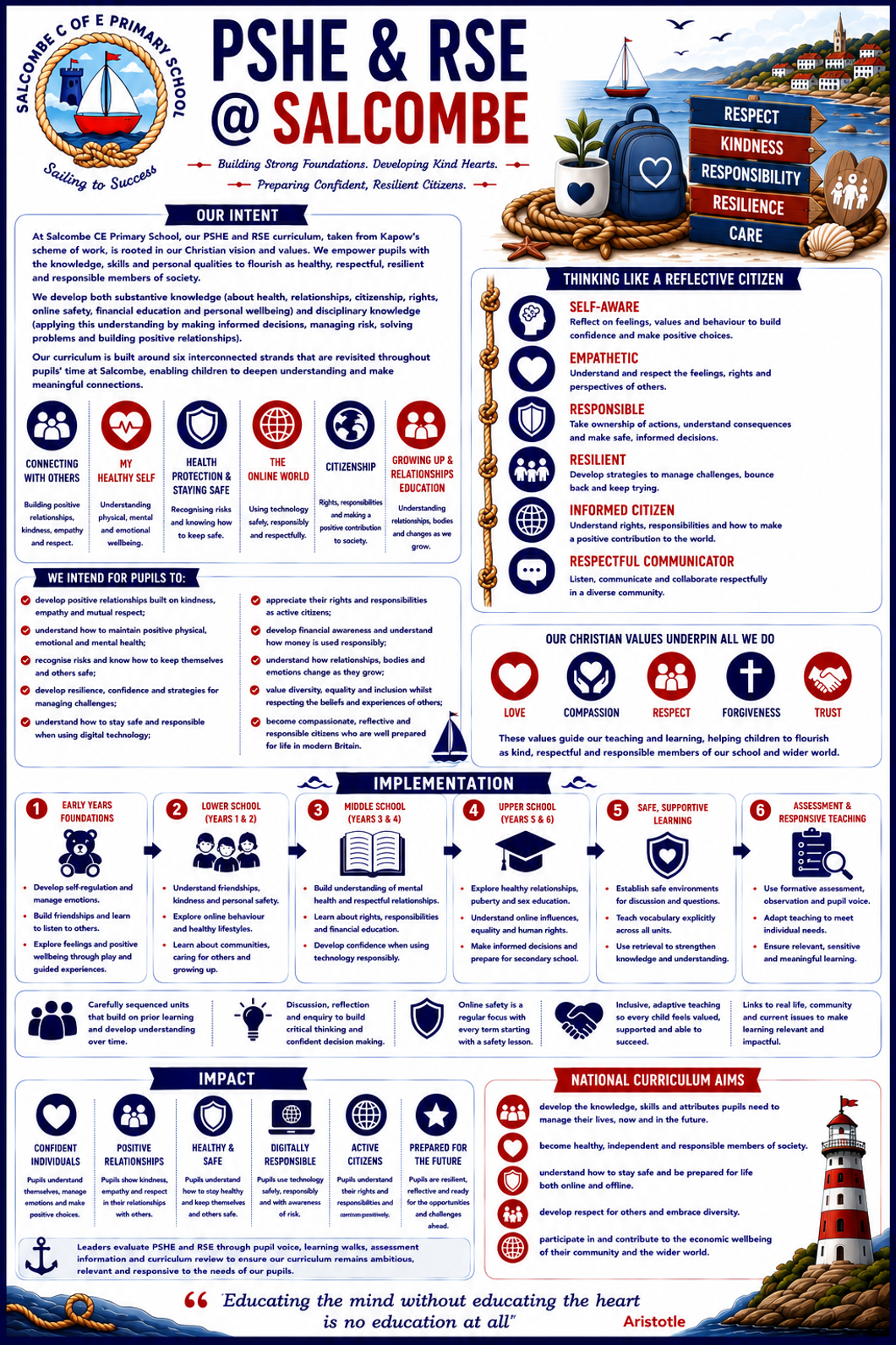
At Salcombe CE Primary School, our Personal, Social, Health and Economic (PSHE) Education and Relationships and Sex Education (RSE) curriculum, taken from Kapow’s scheme of work, is rooted in our Christian vision and values. We believe that every child should develop the knowledge, skills and personal qualities needed to flourish as healthy, respectful, resilient and responsible members of society. Through an ambitious, carefully sequenced curriculum, we empower pupils to understand themselves, build positive relationships, make informed choices and contribute positively to their local community and the wider world.
Serving a rural coastal community in South Devon, we recognise that pupils experience an increasingly complex and rapidly changing world. Our curriculum equips children with the confidence, resilience and emotional literacy needed to navigate these challenges safely and successfully. We believe that PSHE and RSE should provide every child, regardless of their starting point, with the knowledge, understanding and confidence to make positive decisions about their physical health, emotional wellbeing, relationships and future aspirations.
Our curriculum develops both substantive knowledge (knowing about health, relationships, citizenship, rights, responsibilities, online safety, financial education and personal wellbeing) and disciplinary knowledge (applying this understanding by making informed decisions, managing risk, solving problems, communicating effectively, reflecting on personal values and developing positive relationships). Through carefully sequenced learning, pupils progressively develop the confidence, independence and resilience required to flourish both now and in later life.
Our curriculum is built around six interconnected strands:
- Connecting with Others
- My Healthy Self
- Health Protection and Staying Safe
- The Online World
- Citizenship
- Growing Up and Relationships Education
These strands are revisited throughout pupils' time at Salcombe, enabling children to deepen understanding, strengthen prior learning and make meaningful connections between different aspects of personal development.
We intend for pupils to:
- develop positive relationships built on kindness, empathy and mutual respect;
- understand how to maintain positive physical, emotional and mental health;
- recognise risks and know how to keep themselves and others safe;
- develop resilience, confidence and strategies for managing challenges;
- understand how to stay safe and responsible when using digital technology;
- appreciate their rights and responsibilities as active citizens;
- develop financial awareness and understand how money is used responsibly;
- understand how relationships, bodies and emotions change as they grow;
- value diversity, equality and inclusion whilst respecting the beliefs and experiences of others;
- become compassionate, reflective and responsible citizens who are well prepared for life in modern Britain.
Our curriculum has been carefully sequenced to build progressively from children's understanding of themselves, their feelings and their immediate relationships in the Early Years towards increasingly sophisticated exploration of mental wellbeing, healthy relationships, online influences, citizenship, financial responsibility, puberty and sex education in Upper Key Stage Two. Each unit builds upon previous learning, enabling pupils to revisit concepts, deepen understanding and apply learning confidently within increasingly complex contexts.
Ultimately, we aim for every child to leave Salcombe CE Primary School with the confidence, resilience and knowledge to lead healthy, happy and fulfilling lives. We aspire for our pupils to become compassionate, respectful and responsible citizens who make positive contributions to their communities and approach future challenges with confidence and integrity.
Implementation
PSHE and RSE are taught through the carefully sequenced Kapow Primary curriculum, ensuring full statutory coverage of Relationships Education, Health Education and the non-statutory aspects of PSHE. Learning is organised through progressive units which revisit key concepts and enable pupils to deepen their understanding throughout their primary education.
In the Early Years, children begin by developing self-regulation, managing emotions, building positive relationships and developing confidence through the Early Years Framework. Learning focuses upon recognising feelings, building friendships, listening to others and developing positive wellbeing through meaningful play and adult-led experiences.
As pupils progress through Lower School, they develop understanding of friendships, kindness, personal safety, online behaviour, healthy lifestyles, communities and caring for others. They begin to explore growing up in age-appropriate ways whilst developing confidence in making safe choices and understanding their place within the wider community.
In Middle School, pupils build upon these foundations by exploring mental health, respectful relationships, careers, rights and responsibilities, financial education, healthy lifestyles and the responsible use of technology. Learning becomes increasingly reflective and discussion-based, encouraging pupils to consider different viewpoints and make informed decisions.
In Upper School, pupils develop increasingly sophisticated understanding of healthy relationships, online influences, financial responsibility, equality, human rights, puberty and sex education. Through carefully planned discussion and enquiry, pupils learn to evaluate situations, consider consequences and make responsible choices as they prepare for the transition to secondary school.
Vocabulary is explicitly taught throughout every unit, enabling pupils to communicate confidently using increasingly sophisticated language related to emotions, relationships, wellbeing, citizenship and personal safety. Retrieval opportunities are carefully planned to revisit key concepts and strengthen pupils' long-term understanding, allowing learning to build progressively over time.
Adaptive teaching ensures that all pupils can participate confidently in sensitive discussions. Teachers establish safe classroom environments where respectful dialogue is encouraged and pupils feel secure to ask questions, share ideas and develop understanding appropriate to their age and stage of development.
Impact
Teachers use ongoing formative assessment to evaluate pupils' knowledge, understanding, attitudes and personal development throughout each unit of learning. Observation, discussion, reflective activities, questioning and pupil voice enable teachers to identify misconceptions and respond sensitively to pupils' needs whilst ensuring learning remains relevant and meaningful.
As pupils progress through the curriculum, they develop increasing confidence in understanding themselves, managing emotions, building healthy relationships and making informed decisions. They become increasingly resilient, reflective and independent learners who understand how their choices influence both their own wellbeing and the wellbeing of others.
Regular retrieval opportunities ensure that pupils revisit key concepts, vocabulary and learning over time, strengthening understanding and enabling them to make meaningful connections between relationships, health, citizenship and personal responsibility. Through carefully sequenced learning, pupils develop increasingly sophisticated understanding of how to stay physically and emotionally healthy, navigate online environments safely and contribute positively to society.
The impact of our curriculum is evident in pupils who demonstrate kindness, empathy and respect towards others. They communicate confidently, show resilience when faced with challenge and understand the importance of maintaining positive physical and mental health. Pupils recognise their responsibilities as members of their school, local community and wider society whilst appreciating diversity and celebrating difference.
Leaders evaluate the effectiveness of PSHE and RSE through pupil voice, learning walks, assessment information and ongoing curriculum review. This continual cycle of evaluation ensures that the curriculum remains ambitious, relevant and responsive to the needs of pupils and the changing world in which they are growing up.
By the time pupils leave Salcombe CE Primary School, they have developed the knowledge, confidence and resilience to make informed choices, build healthy relationships and manage the opportunities and challenges of modern life. They understand how to keep themselves physically and emotionally healthy, stay safe both online and offline, respect the rights and beliefs of others and contribute positively to their communities. They leave as compassionate, reflective and responsible young people who are well prepared for the next stage of their education and equipped to flourish as active citizens in modern Britain.