Salcombe C of E
Primary School
PE

Physical Education @ Salcombe Church of England Primary School
Intent
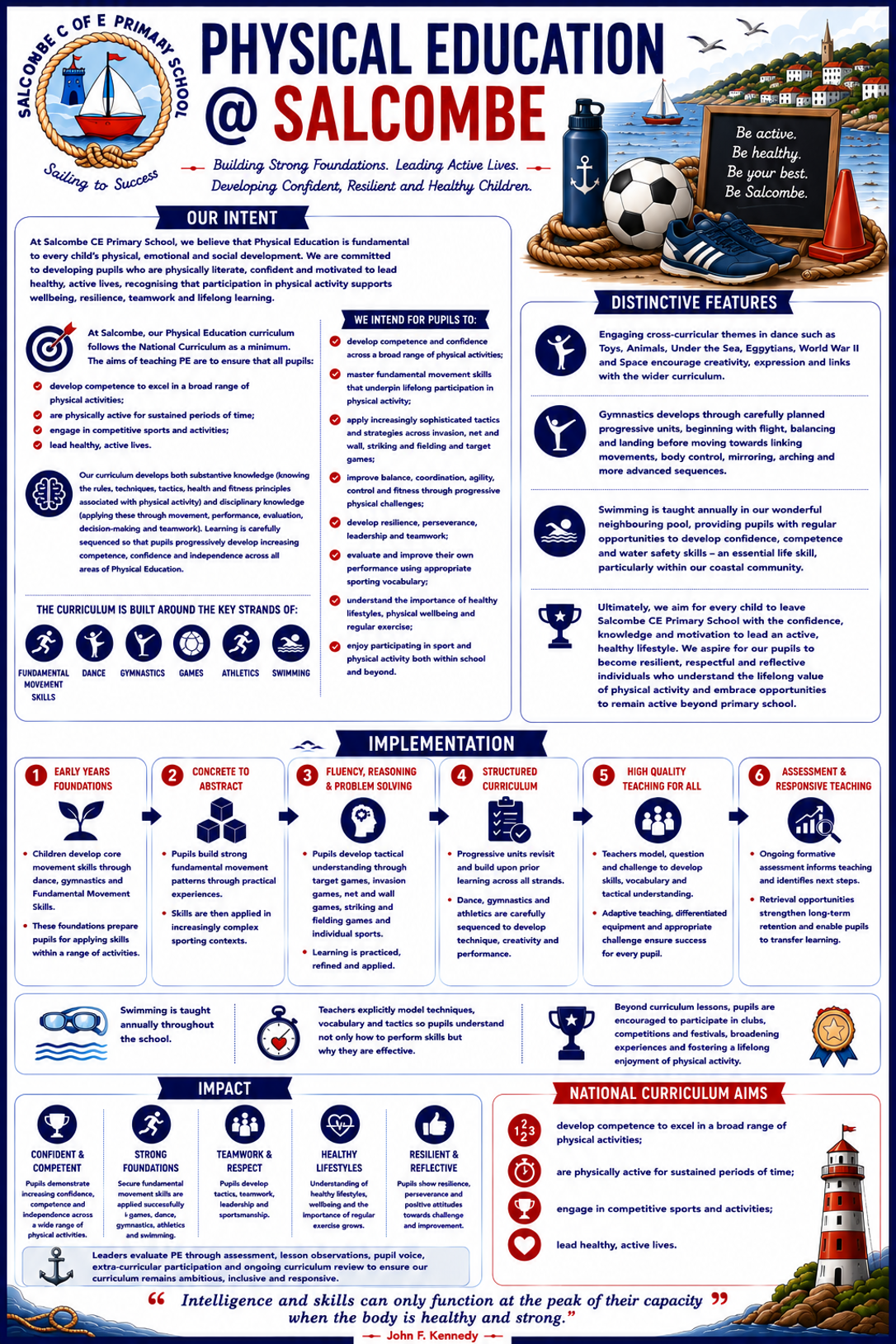
At Salcombe CE Primary School, we believe that Physical Education is fundamental to every child's physical, emotional and social development. We are committed to developing pupils who are physically literate, confident and motivated to lead healthy, active lives, recognising that participation in physical activity supports wellbeing, resilience, teamwork and lifelong learning.
At Salcombe, our Physical Education curriculum follows the National Curriculum as a minimum. The aims of teaching PE are to ensure that all pupils:
- develop competence to excel in a broad range of physical activities;
- are physically active for sustained periods of time;
- engage in competitive sports and activities;
- lead healthy, active lives.
Our curriculum develops both substantive knowledge (knowing the rules, techniques, tactics, health and fitness principles associated with physical activity) and disciplinary knowledge (applying these through movement, performance, evaluation, decision-making and teamwork). Learning is carefully sequenced so that pupils progressively develop increasing competence, confidence and independence across all areas of Physical Education.
The curriculum is built around the key strands of:
- Fundamental Movement Skills
- Dance
- Gymnastics
- Games
- Athletics
- Swimming
These strands are revisited and developed throughout pupils' time at Salcombe, enabling children to strengthen prior learning, refine techniques and apply increasingly sophisticated skills in a range of sporting contexts.
We intend for pupils to:
- develop competence and confidence across a broad range of physical activities;
- master fundamental movement skills that underpin lifelong participation in physical activity;
- apply increasingly sophisticated tactics and strategies across invasion, net and wall, striking and fielding and target games;
- improve balance, coordination, agility, control and fitness through progressive physical challenges;
- develop resilience, perseverance, leadership and teamwork;
- evaluate and improve their own performance using appropriate sporting vocabulary;
- understand the importance of healthy lifestyles, physical wellbeing and regular exercise;
- enjoy participating in sport and physical activity both within school and beyond.
A distinctive feature of our curriculum is the use of engaging cross-curricular themes within dance, including Toys, Animals, Under the Sea, Egyptians, World War II and Space. These themes encourage creativity whilst strengthening links with the wider curriculum and enabling pupils to express ideas through movement. Similarly, gymnastics develops through carefully planned progressive units, beginning with flight, balancing and landing before moving towards linking movements, body control, mirroring, arching and more advanced sequences.
Ultimately, we aim for every child to leave Salcombe CE Primary School with the confidence, knowledge and motivation to lead an active, healthy lifestyle. We aspire for our pupils to become resilient, respectful and reflective individuals who understand the lifelong value of physical activity and embrace opportunities to remain active beyond primary school.
Implementation
Physical Education is taught through a carefully sequenced curriculum that progressively develops pupils' physical competence, knowledge and understanding from the Early Years through to Year 6. Learning is organised through progressive units that revisit and build upon previously taught skills, enabling pupils to strengthen fundamental movement patterns before applying them within increasingly complex sporting contexts.
Children begin by developing core movement skills through dance, gymnastics and Fundamental Movement Skills before applying these within a broad range of games. As pupils progress through the school, they develop tactical understanding through target games, invasion games, net and wall games, striking and fielding games and individual sports including tennis, badminton, athletics and personal challenge activities. This carefully planned progression ensures pupils experience increasing challenge whilst continually building upon prior learning.
Dance and gymnastics are carefully sequenced across the school. Dance themes provide meaningful contexts that encourage creativity, expression and performance, whilst gymnastics units develop progressively from simple balancing, jumping and landing to increasingly sophisticated movement patterns, linking sequences, body control and partner work.
Swimming is taught annually throughout the school, in our wonderful neighbouring pool, providing pupils with regular opportunities to develop confidence, competence and water safety skills. This consistent provision reflects the importance of swimming as both a statutory National Curriculum requirement and an essential life skill, particularly within our coastal community.
Teachers explicitly model techniques, vocabulary and tactical understanding, enabling pupils to understand not only how to perform skills but why they are effective within different sporting situations. Retrieval opportunities are embedded throughout the curriculum as pupils revisit previously learned movement patterns, rules and tactical concepts, strengthening long-term retention and enabling pupils to transfer learning between different activities.
Adaptive teaching ensures that every pupil experiences success. Teachers use modelling, demonstrations, questioning, differentiated equipment and appropriate challenge to ensure that all children make strong progress whilst maintaining consistently high expectations.
Beyond curriculum lessons, pupils are encouraged to participate in clubs, competitions and festivals, broadening their sporting experiences and fostering a lifelong enjoyment of physical activity.
Impact
Teachers use ongoing formative assessment to evaluate pupils' physical competence, knowledge, understanding and application of skills throughout each unit of learning. Observation, questioning, peer assessment and self-evaluation enable teachers to identify next steps and adapt teaching responsively to meet pupils' needs.
As pupils progress through the curriculum, they demonstrate increasing confidence, competence and independence across an increasingly broad range of physical activities. They build secure fundamental movement skills before applying these successfully within games, dance, gymnastics, athletics and swimming. Their understanding of tactics, teamwork, leadership and healthy lifestyles develops progressively alongside their physical competence.
Regular opportunities to revisit previously learned skills ensure pupils strengthen their physical literacy and retain key knowledge over time. Through carefully sequenced learning, pupils refine techniques, improve performance and develop resilience when faced with increasingly challenging physical tasks.
The impact of our curriculum is evident in pupils who participate enthusiastically, demonstrate excellent sportsmanship and show confidence when working both independently and collaboratively. They understand the importance of healthy competition, perseverance and supporting others whilst developing increasingly positive attitudes towards physical activity.
Leaders evaluate the effectiveness of Physical Education through assessment information, lesson observations, pupil voice, participation in extra-curricular sport and ongoing curriculum review. This continual evaluation ensures that our curriculum remains ambitious, inclusive and responsive to pupils' needs.
By the time pupils leave Salcombe CE Primary School, they have developed the knowledge, skills and confidence to participate successfully in a broad range of physical activities. They understand the importance of leading healthy, active lives and leave as resilient, reflective and respectful young people who are equipped to continue participating in sport and physical activity throughout secondary school and beyond.