Salcombe C of E
Primary School
Modern Foreign Languages

Modern Foreign Languages @ Salcombe Primary School
Intent
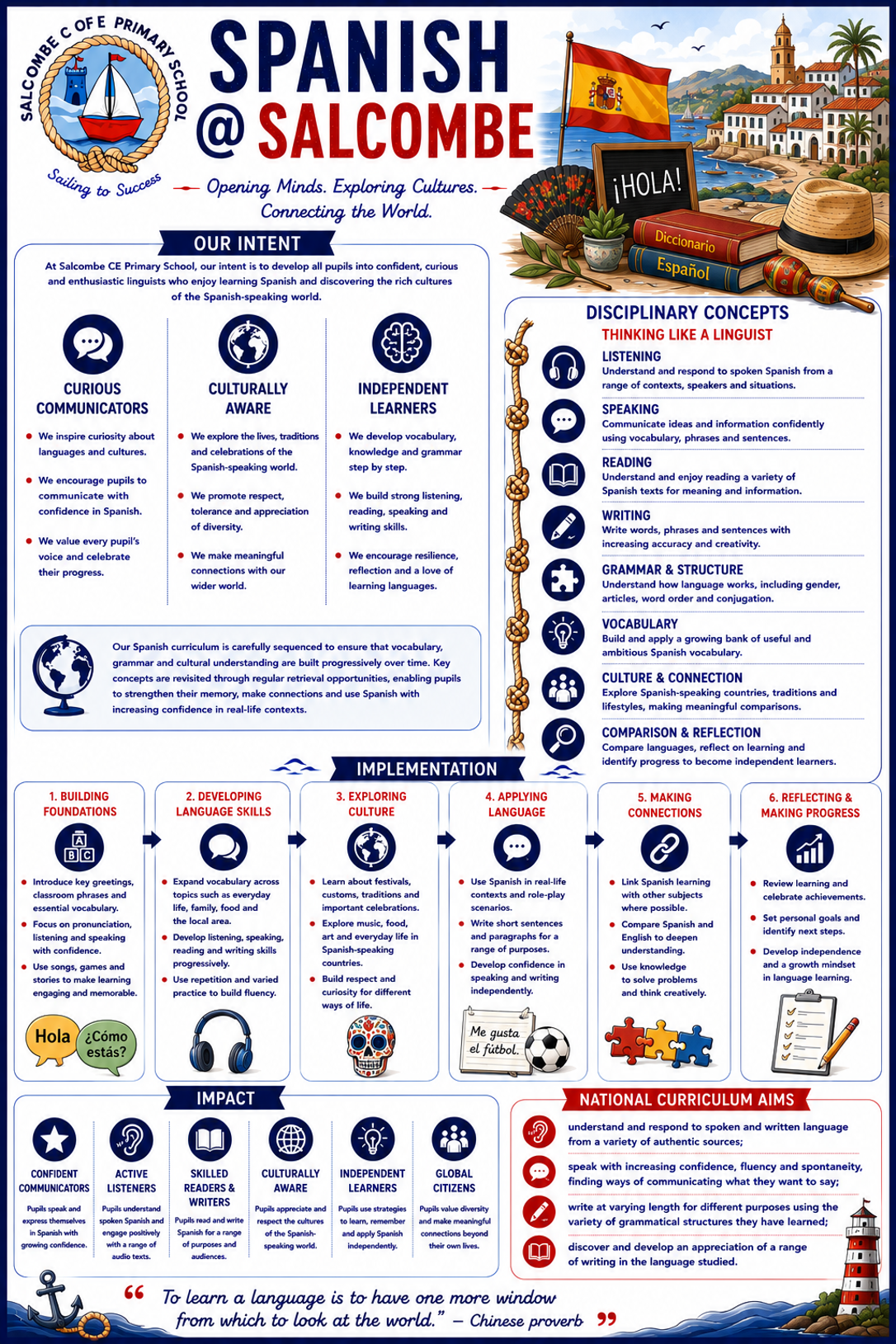
At Salcombe CE Primary School, our intent is to develop all pupils into confident, curious and enthusiastic linguists who develop a lifelong appreciation of languages and the diverse cultures they represent. In alignment with the National Curriculum, our Spanish curriculum is underpinned by the understanding that learning a modern foreign language provides an opening to other cultures whilst fostering curiosity, confidence and respect for others. Through carefully sequenced learning, pupils develop both substantive knowledge (knowing vocabulary, grammar, phonics and cultural understanding) and disciplinary knowledge (thinking and communicating as linguists through speaking, listening, reading and writing), enabling them to communicate with increasing confidence, fluency and accuracy.
At Salcombe, our Spanish curriculum follows the objectives of the National Curriculum as a minimum. The aims of teaching a modern foreign language are to ensure that all pupils:
- understand and respond to spoken and written language from a variety of authentic sources;
- speak with increasing confidence, fluency and spontaneity, finding ways of communicating what they want to say;
- write at varying length for different purposes using the variety of grammatical structures they have learned;
- discover and develop an appreciation of a range of writing in the language studied.
Our curriculum is built around the key strands of speaking, listening, reading, writing, phonics, grammar, vocabulary and intercultural understanding. These strands are revisited throughout Key Stage Two, enabling pupils to deepen their understanding, make meaningful connections and apply previously learned language with increasing independence. Children develop confidence through repeated opportunities to rehearse, retrieve and apply vocabulary and grammatical structures in a range of familiar and increasingly unfamiliar contexts.
We intend for pupils to:
- develop confidence and enjoyment in communicating in Spanish;
- listen attentively and respond accurately to spoken Spanish;
- speak with increasing confidence, fluency and accurate pronunciation;
- read and understand familiar words, phrases and increasingly complex texts;
- write words, phrases and simple sentences from memory with growing independence;
- acquire and confidently apply a broad range of topic-based vocabulary;
- understand and apply key grammatical structures, including nouns, adjectives, verbs and sentence patterns;
- recognise similarities and differences between languages, developing strategies for future language learning;
- appreciate the culture, traditions and geography of Spain and the wider Spanish-speaking world;
- become resilient, curious and confident language learners who are prepared for further language study.
Ultimately, we aim to ensure that every child leaves Salcombe CE Primary School with the confidence to communicate in basic Spanish, an appreciation of different cultures and a genuine enthusiasm for language learning. We aspire for our pupils to become respectful global citizens who recognise that learning another language broadens horizons, strengthens communication skills and opens doors to future opportunities.
Implementation
Spanish is taught throughout Key Stage Two through carefully sequenced thematic units that progressively develop pupils' confidence in speaking, listening, reading and writing. Learning is structured to revisit previously taught vocabulary and grammatical concepts whilst introducing new language in manageable steps. Lessons provide regular opportunities for pupils to practise pronunciation, retrieve previously learned vocabulary and apply new language through purposeful communication.
Our curriculum has been carefully sequenced to ensure that vocabulary, grammar, pronunciation and communication skills are built progressively over time. Core vocabulary and grammatical structures are deliberately revisited through carefully planned retrieval opportunities, enabling pupils to strengthen their understanding, retain language within their long-term memory and apply previously learned knowledge in new contexts. We recognise that children learn languages most effectively through frequent opportunities to hear, speak, read and write the language within meaningful and engaging situations.
Each year begins by celebrating the European Day of Languages, encouraging pupils to value multilingualism and understand the importance of languages within an increasingly interconnected world. As pupils progress through the curriculum, they develop language through engaging contexts including everyday communication, shopping at the market, Spanish celebrations, weather and climate, and the Amazon Rainforest. These carefully chosen themes provide authentic opportunities to communicate whilst making meaningful links with geography and wider curriculum learning.
Teachers explicitly model accurate pronunciation, grammar and sentence structure, enabling pupils to communicate with increasing confidence and independence. Children develop their understanding of key grammatical concepts including noun gender, articles, adjectives, simple verb forms, sentence construction and question formation. Vocabulary is introduced systematically before being revisited regularly through retrieval practice and practical application.
Oracy lies at the heart of our Spanish curriculum. Pupils regularly engage in structured conversations, role play, questioning and collaborative speaking activities that encourage them to communicate confidently using increasingly ambitious vocabulary. Reading and writing opportunities build progressively from recognising familiar words and phrases to reading short texts and writing increasingly independent sentences for meaningful purposes.
Intercultural understanding is woven throughout every unit. Pupils explore the geography, traditions, celebrations and daily life of Spain and the wider Spanish-speaking world, recognising both similarities and differences between their own lives and those of others. Through these experiences, pupils develop respect for diversity and gain an appreciation of how language helps people connect across cultures.
Each year concludes with a consolidating pen pal project, enabling pupils to revisit and apply previously learned vocabulary, grammar and sentence structures through authentic communication. Writing for a real audience develops confidence, purpose and independence whilst demonstrating how language learning extends beyond the classroom with our friends at Colegio Infanta Leonora de Mazarron, Spain.
Adaptive teaching ensures all pupils access ambitious language learning. Teachers use modelling, repetition, visual prompts, retrieval practice, sentence stems, partner talk and scaffolded activities to support language acquisition whilst maintaining high expectations for every learner. Opportunities for challenge allow pupils to manipulate language independently, extend conversations and apply grammatical knowledge creatively.
Impact
Teachers use a range of formative and summative assessment strategies to assess pupils' vocabulary acquisition, grammatical understanding and communication skills throughout each unit. Observation, questioning, conversation, reading activities, written work and retrieval practice enable teachers to identify misconceptions and adapt teaching responsively. Assessment focuses on pupils' ability to communicate effectively as well as their developing knowledge of vocabulary and grammar.
At the end of each unit, pupils demonstrate their learning through purposeful speaking, listening, reading or writing outcomes linked to the unit's context. The annual consolidation and pen pal projects provide authentic opportunities for pupils to apply their learning independently, demonstrating their ability to communicate for a genuine purpose. Teachers use these outcomes to assess pupils' understanding against the National Curriculum expectations and to inform future planning.
As pupils progress through the curriculum, they develop increasingly secure vocabulary, pronunciation and grammatical understanding alongside growing confidence in communicating in Spanish. They become increasingly fluent in responding to spoken language, reading familiar texts and expressing themselves through simple spoken and written sentences. Their understanding of Spanish-speaking cultures broadens alongside their appreciation of the wider world and the importance of communication across cultures.
Regular retrieval practice, revisiting of key vocabulary and carefully sequenced progression ensure that pupils know more, remember more and make increasingly sophisticated connections across the Spanish curriculum. Professional dialogue and ongoing assessment support consistency in teacher judgement and contribute to the continual refinement of curriculum provision.
The impact of our curriculum is evident in pupils who approach language learning with enthusiasm, confidence and curiosity. They willingly communicate in Spanish, demonstrate resilience when learning unfamiliar vocabulary and appreciate the cultural richness of the Spanish-speaking world. They understand that learning another language develops communication, confidence and respect for others whilst preparing them to thrive in an increasingly connected global society.
By the time pupils leave Salcombe CE Primary School, they possess a secure foundation in Spanish, the confidence to communicate using familiar vocabulary and grammatical structures, and a genuine enthusiasm for language learning. They leave equipped not only for the next stage of their education but also as curious, respectful and globally minded citizens who value diversity, embrace new experiences and recognise the importance of languages in the modern world.