Salcombe C of E
Primary School
History

History @ Salcombe Church of England Primary School
History @ Salcombe CE Primary
Intent
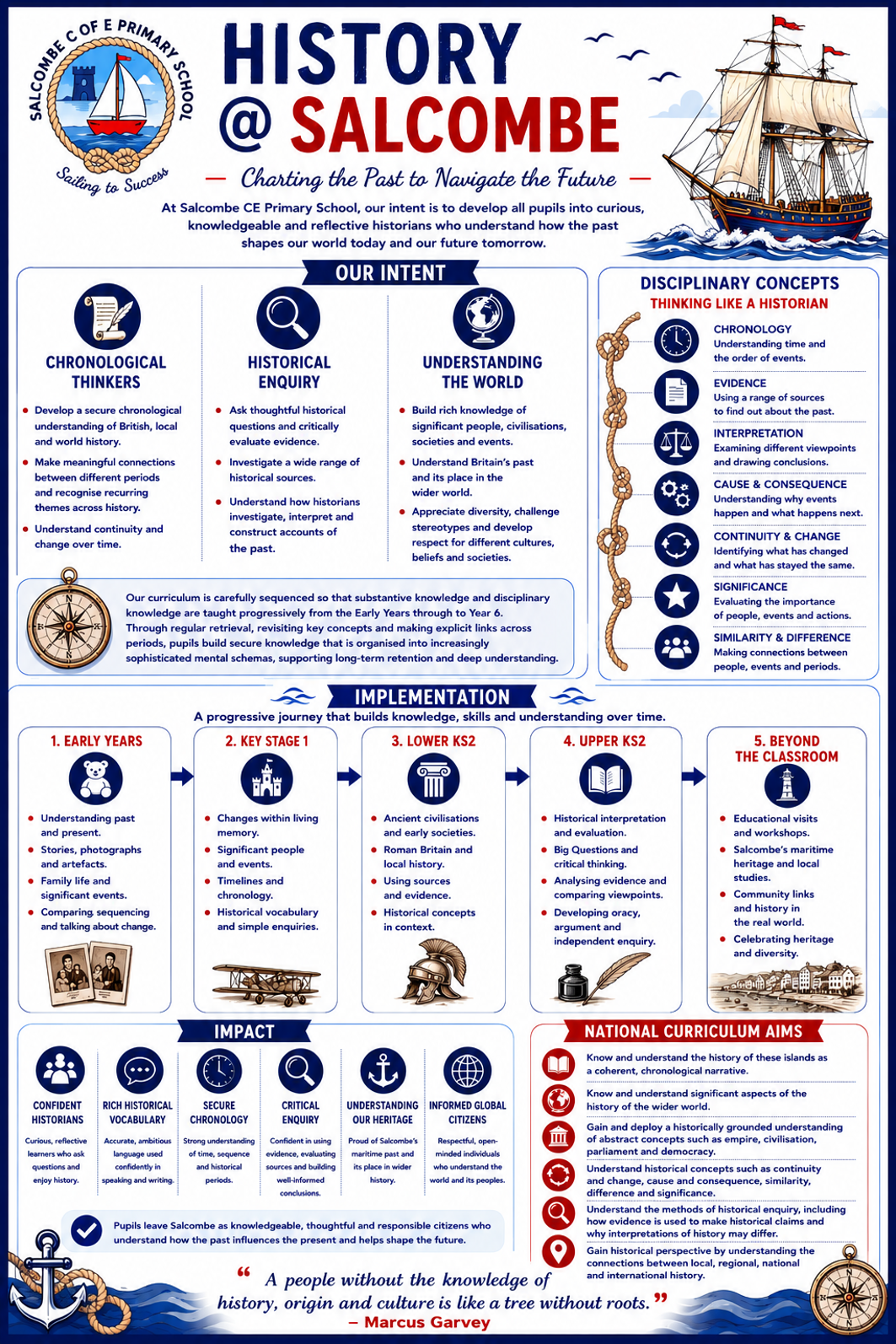
At Salcombe CE Primary School, our intent is to develop all pupils into curious, knowledgeable and reflective historians who develop a secure understanding of Britain's past and the wider world whilst recognising the importance of history in shaping their own lives today. In alignment with the National Curriculum, our curriculum is underpinned by the understanding that history is far more than learning isolated facts; it is about developing pupils' understanding of chronology, historical enquiry and the substantive and disciplinary knowledge needed to think critically about the past.
Our bespoke curriculum has been carefully designed to reflect both our unique coastal setting and the needs of our pupils. Nestled along the stunning South Devon coastline, Salcombe's rich maritime heritage provides authentic opportunities for children to explore how trade, exploration, migration, conflict and innovation have shaped both our local community and the wider world. By making meaningful links between local, national and global history, pupils develop a sense of place whilst understanding Britain's role within an increasingly interconnected world.
We intend for pupils to:
- Develop a secure chronological understanding of British, local and world history.
- Build rich substantive knowledge of significant people, civilisations, societies and events.
- Develop disciplinary knowledge by understanding how historians investigate, interpret and construct accounts of the past.
- Ask thoughtful historical questions and critically evaluate a range of historical evidence.
- Understand the concepts of continuity and change, cause and consequence, similarity and difference, significance and historical interpretation.
- Use ambitious historical vocabulary accurately and confidently.
- Make meaningful connections between different historical periods and recognise recurring themes across history.
- Appreciate diversity, challenge stereotypes and develop respect for different cultures, beliefs and societies.
- Become increasingly curious, reflective learners who understand the relevance of history in today's world.
Our curriculum has been carefully sequenced to ensure that both substantive knowledge and disciplinary knowledge are taught progressively from the Early Years through to Year 6. We recognise that pupils learn history most effectively when new knowledge builds upon secure prior learning, enabling them to organise historical knowledge into increasingly sophisticated mental schemas. Through regular retrieval practice, revisiting key concepts and making explicit links across different periods of history, pupils strengthen both their understanding and long-term retention.
We intend to provide:
- High-quality historical enquiries centred around meaningful 'Big Questions'.
- Explicit teaching of chronology, historical vocabulary and disciplinary thinking.
- Opportunities to investigate a wide range of historical sources and evidence.
- Rich discussions which develop pupils' oracy, reasoning and historical argument.
- Meaningful opportunities to study Salcombe's local history alongside Britain's wider historical narrative.
- Adaptive teaching and carefully planned scaffolding to ensure all pupils achieve success as historians.
Ultimately, we aim to ensure every child leaves Salcombe CE Primary School with a secure understanding of Britain's history and its place within the wider world. They will understand that history is constructed through evidence, interpretation and enquiry and will possess the curiosity, critical thinking and cultural understanding needed to become informed citizens who appreciate how the past continues to shape the future.
At Salcombe, our history curriculum follows the objectives of the National Curriculum as a minimum. The aims of teaching history, as outlined in the National Curriculum, are to ensure that all pupils:
- know and understand the history of these islands as a coherent, chronological narrative;
- know and understand significant aspects of the history of the wider world;
- gain and deploy a historically grounded understanding of abstract concepts such as empire, civilisation, parliament and democracy;
- understand historical concepts such as continuity and change, cause and consequence, similarity, difference and significance;
- understand the methods of historical enquiry, including how evidence is used to make historical claims and why interpretations of history may differ;
- gain historical perspective by understanding the connections between local, regional, national and international history.
Implementation
In the Early Years, children begin developing historical understanding through the ‘Understanding the World’ area of learning. Through stories, photographs, artefacts, discussions about family life and exploration of their own experiences, children begin to understand the concepts of past and present. They compare similarities and differences, sequence familiar events and begin developing an awareness that people's lives change over time. Adults carefully model historical vocabulary and encourage children to talk about change, memory and significant events, laying strong foundations for future historical learning.
As pupils move into Key Stage One, learning builds systematically upon these foundations. Children begin by exploring their own lives and those of people within living memory before studying events beyond living memory and significant individuals who have shaped Britain and the wider world. During this phase, teachers explicitly develop pupils' understanding of chronology, introducing timelines and helping children organise historical events within a coherent narrative. Big ideas, such as exploration, innovation and significant British events, begin to emerge through carefully selected units which encourage pupils to compare life across different periods whilst making meaningful links to their own experiences.
As pupils progress into Key Stage Two, they encounter increasingly sophisticated historical enquiries. Britain's history is taught as a coherent chronological narrative whilst being enriched through the study of ancient civilisations, world history and local history. Pupils investigate the achievements and influence of societies such as Ancient Egypt, Ancient Greece and early Islamic civilisation alongside significant periods in British history. Throughout these studies, pupils revisit and deepen their understanding of chronology, continuity and change, cause and consequence, similarity and difference, significance and historical interpretation, enabling them to think with increasing sophistication as historians.
Central to our curriculum is the explicit teaching of disciplinary knowledge. Teachers model how historians ask questions, analyse evidence, evaluate reliability and construct interpretations based upon available sources. Pupils investigate a wide range of evidence, including artefacts, maps, photographs, census records, letters, diaries, paintings, archaeological discoveries and oral histories. Through rich discussion and structured enquiry, children develop the confidence to justify their opinions using historical evidence whilst recognising that different interpretations may exist.
Historical enquiry sits at the heart of every unit. Learning is driven by carefully chosen 'Big Questions' that provide a clear purpose for pupils' investigations and encourage deeper thinking. Lessons are carefully sequenced to develop knowledge progressively whilst providing opportunities for pupils to discuss and explain historical concepts using increasingly ambitious vocabulary which is explicitly planned and systematically revisited throughout every unit. Oracy is an integral feature of history lessons, allowing pupils to articulate ideas, challenge viewpoints and develop reasoned historical arguments before recording their learning.
Our curriculum celebrates the unique maritime heritage of Salcombe wherever appropriate. Pupils explore how our coastal location has influenced trade, exploration, fishing, conflict and community life across different historical periods. Educational visits, local studies and engagement with historical sites further enrich pupils' understanding, enabling them to appreciate the significance of their local community within Britain's wider historical narrative.
Adaptive teaching ensures all pupils access ambitious historical learning. Teachers carefully scaffold learning through modelling, visual resources, vocabulary support and targeted questioning whilst providing opportunities for greater depth through extended enquiry, deeper thinking and sophisticated historical reasoning.
Impact
Teachers use a range of formative and summative assessment strategies to evaluate pupils' historical knowledge, understanding and disciplinary thinking. Throughout lessons, retrieval practice, questioning, discussion and carefully designed enquiry activities enable teachers to identify misconceptions and adapt teaching responsively.
At the end of each unit, pupils answer the unit's overarching 'Big Question'. These assessments enable teachers to evaluate pupils' understanding of substantive knowledge alongside their ability to think critically as historians.
As pupils progress through the curriculum, they develop increasingly secure chronological understanding and become confident in using historical vocabulary, analysing evidence and constructing historically valid arguments. They recognise patterns of continuity and change across different periods, understand the significance of historical events and appreciate that interpretations of the past are constructed through careful analysis of evidence.
Regular retrieval practice ensures pupils know more and remember more over time. Moderation and professional dialogue support accurate teacher assessment and inform future curriculum planning, ensuring that learning continues to build progressively across each year group.
The impact of our curriculum is evident in pupils who are enthusiastic historians, ask thoughtful questions and confidently discuss historical concepts using precise vocabulary. They understand how local, national and global histories are interconnected and appreciate how the actions of individuals and societies have shaped the world in which they live today.
By the time pupils leave Salcombe CE Primary School, they possess a rich body of historical knowledge, a well-developed understanding of historical enquiry and a genuine curiosity about the past. They leave equipped not only with the knowledge required for secondary education but also with the critical thinking, empathy and cultural understanding needed to become informed citizens who are prepared to make a positive contribution to the future.