
Salcombe C of E
Primary School
Music

Music @ Salcombe CE Primary School
Intent
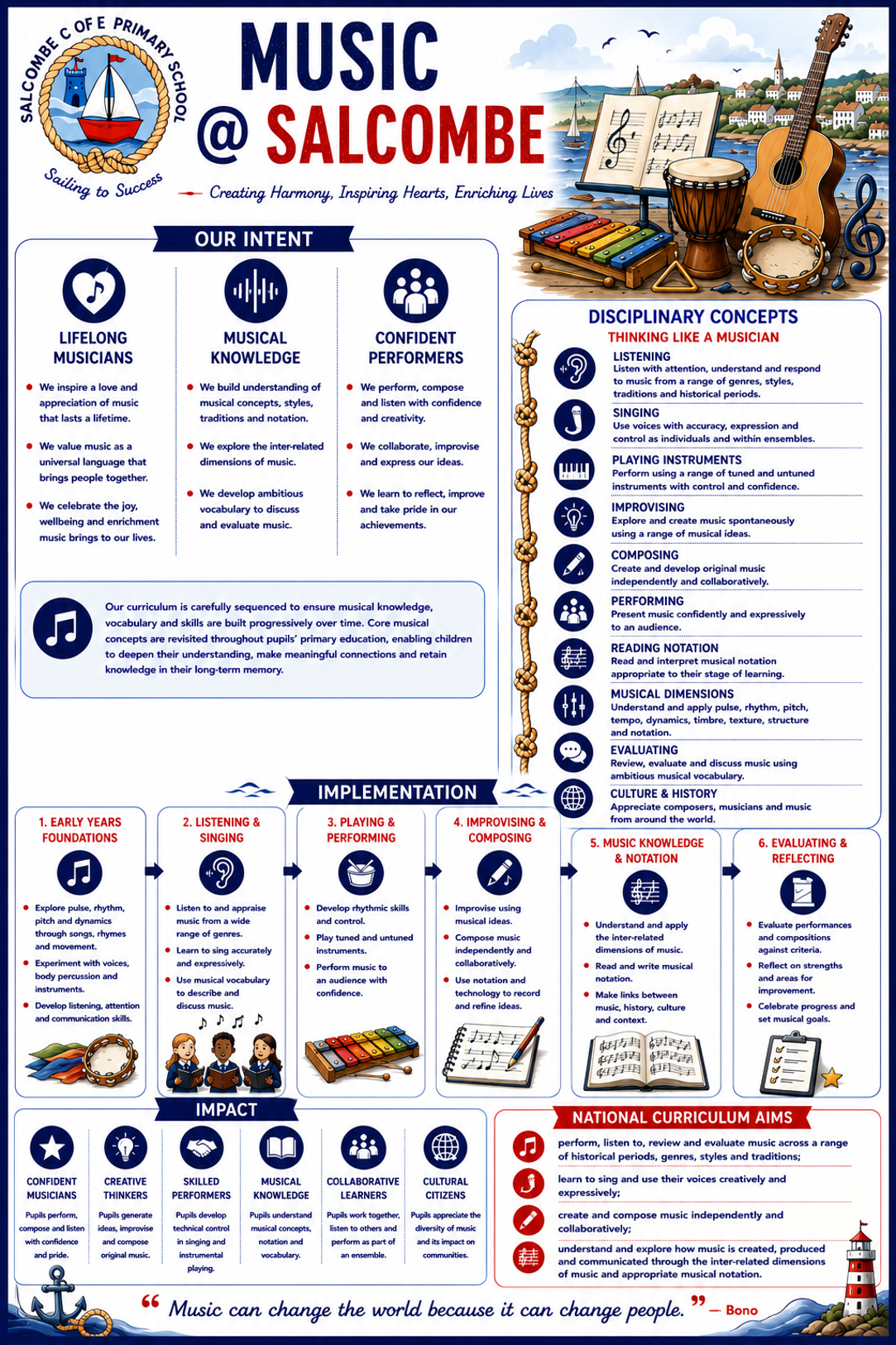
At Salcombe CE Primary School, our intent is to develop all pupils into confident, creative and expressive musicians who develop a lifelong appreciation of music and its power to inspire, communicate and bring people together. In alignment with the National Curriculum and the Model Music Curriculum, our music curriculum is underpinned by the understanding that music is a universal language which transcends cultural, social and historical boundaries. Through carefully sequenced learning, pupils develop both substantive knowledge (knowing about musical concepts, styles, traditions and notation) and disciplinary knowledge (thinking and working as musicians through listening, performing, composing and evaluating), enabling them to become confident performers, composers and critical listeners.
At Salcombe, our music curriculum follows the objectives of the National Curriculum and the Model Music Curriculum as a minimum. The aims of teaching music are to ensure that all pupils:
- perform, listen to, review and evaluate music across a range of historical periods, genres, styles and traditions;
- learn to sing and use their voices creatively and expressively;
- create and compose music independently and collaboratively;
- understand and explore how music is created, produced and communicated through the inter-related dimensions of music and appropriate musical notation.
Our bespoke curriculum, delivered through the Charanga Musical School programme, has been carefully designed alongside County experts, to ensure clear progression from Nursery through to Year 6 whilst meeting the needs of our mixed-age classes. They learn that music is both an art form and a powerful means of communication that reflects communities, cultures and individual identities. Through singing, instrumental performance, improvisation and composition, pupils develop creativity, resilience, collaboration and confidence whilst discovering the joy of making music together.
Our curriculum is built around the key musical concepts of listening, singing, playing instruments, improvising, composing, performing, reading notation and understanding the inter-related dimensions of music including pulse, rhythm, pitch, tempo, dynamics, timbre, texture, structure and notation. These concepts are revisited throughout pupils' primary education, enabling children to deepen their understanding and make increasingly sophisticated musical connections.
We intend for pupils to:
- develop a lifelong love and appreciation of music;
- perform confidently using their voices and a range of tuned and untuned instruments;
- sing accurately and expressively as individuals and within ensembles;
- improvise and compose original music using an increasing range of musical ideas;
- develop fluency in reading and interpreting musical notation appropriate to their stage of learning;
- understand and apply the inter-related dimensions of music when listening, performing and composing;
- listen critically to music from a broad range of genres, cultures and historical periods;
- use ambitious musical vocabulary to discuss, analyse and evaluate music confidently;
- appreciate the contribution of significant composers, performers and musicians from across the world;
- develop confidence, resilience, creativity, collaboration and self-expression through shared musical experiences.
Our curriculum has been carefully sequenced to ensure that musical knowledge, vocabulary and disciplinary skills are built progressively over time. Core musical concepts are deliberately revisited through carefully planned retrieval opportunities, enabling pupils to strengthen their understanding, retain knowledge within their long-term memory and apply previous learning to increasingly complex musical experiences. We recognise that children learn music most effectively through regular opportunities to listen, perform, compose, reflect and improve.
Ultimately, we aim to ensure that every child leaves Salcombe CE Primary School with the confidence to perform, compose, listen critically and express themselves through music. We aspire for our pupils to become enthusiastic musicians who appreciate the richness and diversity of music and recognise its ability to enrich their own lives and those of others.
Implementation
In the Early Years, children begin developing musical understanding through the Expressive Arts and Design area of learning. Through songs, rhymes, movement, musical play and carefully planned adult-led experiences, children explore pulse, rhythm, pitch and dynamics whilst developing listening, attention and communication skills. They experiment with voices, body percussion and simple instruments, learning to respond to music creatively and confidently. These early experiences nurture curiosity, self-expression and enjoyment whilst laying the foundations for future musical learning.
As pupils move into Key Stage One, learning builds upon these foundations through carefully sequenced Charanga units that develop listening, singing, rhythm, pulse and early composition. Pupils begin to recognise musical patterns, perform simple rhythms, sing accurately and play tuned and untuned percussion instruments with increasing control. Teachers explicitly introduce musical vocabulary and notation whilst encouraging pupils to discuss music using appropriate terminology. Children explore music inspired by the world around them and begin composing simple musical ideas for different purposes.
Throughout Key Stage Two, pupils revisit and deepen their understanding of musical concepts through increasingly sophisticated musical experiences. Learning develops pupils' confidence in singing, ensemble performance, improvisation, composition and notation whilst introducing a broader range of musical styles, traditions and cultures. Children progressively develop their understanding of pitch, harmony, structure, texture, dynamics and musical form whilst refining instrumental techniques and ensemble skills. Opportunities to learn instruments such as the recorder and samba percussion enable pupils to perform with increasing technical accuracy and musical expression.
Each unit is driven by a carefully structured sequence of listening, performing, composing and evaluating. Teachers explicitly model musical thinking, enabling pupils to listen critically, identify musical features, experiment with ideas, refine compositions and evaluate performances. Pupils are encouraged to justify their musical choices using ambitious subject-specific vocabulary whilst recognising that rehearsal, reflection and refinement are essential elements of successful performance.
Practical music making lies at the heart of our curriculum. Singing is central to every phase of learning and is embedded within lessons, collective worship, performances and wider school life. Pupils regularly perform both individually and collaboratively, developing confidence, teamwork and resilience through shared musical experiences. Opportunities to perform for audiences—including assemblies, church services, seasonal celebrations and productions—enable children to experience the purpose and enjoyment of live performance.
Vocabulary is explicitly planned and systematically revisited throughout every unit. Retrieval practice is embedded within lessons, enabling pupils to strengthen long-term memory and make meaningful connections between previous and current learning. Musical notation is introduced progressively, allowing pupils to develop increasing fluency in reading, interpreting and creating music. Oracy plays an important role within music, with pupils regularly discussing musical features, evaluating performances and explaining compositional decisions using ambitious musical vocabulary.
Adaptive teaching ensures all pupils access ambitious musical learning. Teachers use modelling, scaffolding, repetition, visual prompts, notation support, targeted questioning and practical demonstration to enable all learners to succeed whilst maintaining high expectations. Opportunities for challenge allow pupils to perform with increasing independence, compose creatively and evaluate music critically.
Impact
Teachers use a range of formative and summative assessment strategies to assess pupils' musical knowledge, practical skills and disciplinary understanding throughout each unit. Observation, questioning, performance, discussion, retrieval practice and practical music making enable teachers to identify misconceptions and adapt teaching responsively. Assessment values both musical understanding and practical application, recognising that music is learned most effectively through active participation.
At the end of each unit, pupils demonstrate their learning through performance, composition or musical outcomes that reflect the unit's focus. Teachers assess pupils' progress against National Curriculum expectations, using these outcomes alongside ongoing formative assessment to inform future planning and ensure progression.
As pupils progress through the curriculum, they develop increasingly secure musical knowledge alongside the confidence to perform, compose, improvise and evaluate music independently. They become increasingly fluent in recognising musical features, interpreting notation and communicating musical ideas using accurate subject-specific vocabulary. Their appreciation of music broadens as they encounter a diverse range of composers, performers, cultures and traditions.
Regular retrieval practice, revisiting of key musical concepts and carefully sequenced progression ensure that pupils know more, remember more and make increasingly sophisticated connections across the music curriculum. Professional dialogue and moderation support consistency in teacher assessment and contribute to the continual refinement of curriculum provision.
The impact of our curriculum is evident in pupils who approach music with enthusiasm, curiosity and confidence. They willingly perform, compose and collaborate with others whilst demonstrating resilience, creativity and pride in their musical achievements. They appreciate the cultural significance of music, understand its role in bringing people together and confidently express themselves through musical performance and composition.
By embedding our Christian ethos and values, when pupils leave Salcombe CE Primary School, they possess a secure understanding of the inter-related dimensions of music, the confidence to perform and compose with increasing independence, and a genuine appreciation of music in all its forms. They leave equipped not only for the next stage of their musical education but also as creative, expressive and culturally aware individuals who recognise the value of music throughout their lives.