Salcombe C of E
Primary School
Science

Science @ Salcombe Church of England Primary School
Intent
At Salcombe CE Primary School, we believe that science is fundamental to understanding the world around us. Through an ambitious, carefully sequenced curriculum, we develop curious, inquisitive and reflective learners who are inspired to ask questions, seek answers and develop a lifelong fascination with the natural and physical world. We believe that science enables children to make sense of their experiences whilst equipping them with the knowledge, skills and understanding needed to become informed citizens in an increasingly scientific and technological society.
Serving a rural coastal community in South Devon, we recognise the unique opportunities our local environment provides for scientific enquiry and exploration. Our curriculum encourages pupils to observe, investigate and question the world around them whilst developing an appreciation of how science influences everyday life, the environment and future innovation. We believe that every child should experience the excitement of discovery and understand that science is relevant to their lives both now and in the future.
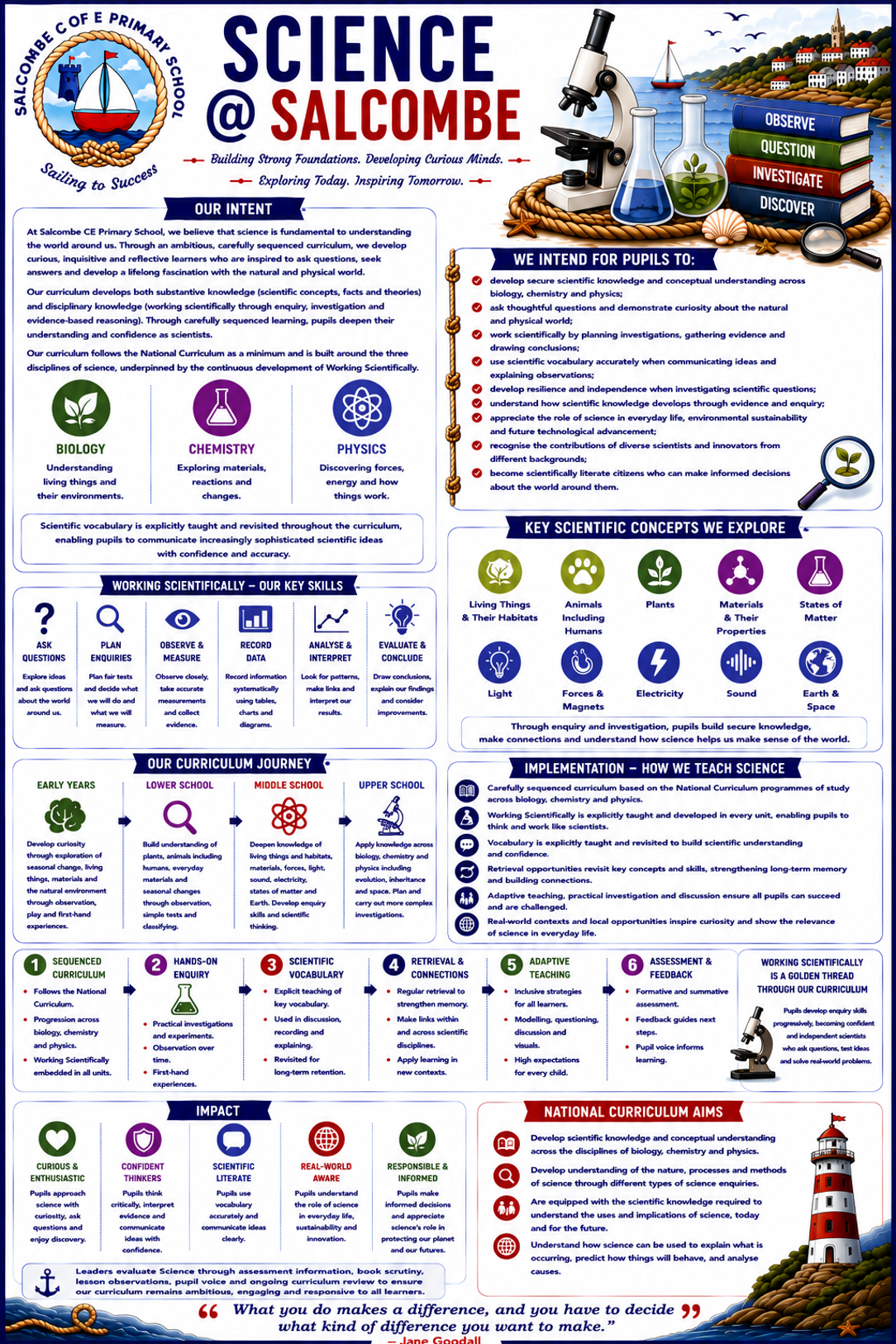
Our curriculum develops both substantive knowledge (knowing scientific concepts, facts, vocabulary and theories within biology, chemistry and physics) and disciplinary knowledge (working scientifically by asking questions, planning enquiries, observing over time, identifying patterns, carrying out comparative and fair tests, gathering and interpreting evidence, and drawing conclusions). Through carefully sequenced learning, pupils progressively deepen their scientific understanding whilst developing the skills and confidence to think and work as scientists.
At Salcombe, our Science curriculum follows the National Curriculum as a minimum. Through the programmes of study, pupils develop secure knowledge within biology, chemistry and physics whilst learning to work scientifically through practical enquiry, observation, investigation and evidence-based reasoning. Our curriculum is built around the three disciplines of science:
- Biology
- Chemistry
- Physics
These disciplines are underpinned by the continuous development of Working Scientifically, ensuring that pupils apply scientific knowledge through enquiry, investigation and evidence-based reasoning. Scientific vocabulary is explicitly taught and revisited throughout the curriculum, enabling pupils to communicate increasingly sophisticated scientific ideas with confidence and accuracy.
We intend for pupils to:
- develop secure scientific knowledge and conceptual understanding across biology, chemistry and physics;
- ask thoughtful questions and demonstrate curiosity about the natural and physical world;
- work scientifically by planning investigations, gathering evidence and drawing conclusions;
- use scientific vocabulary accurately when communicating ideas and explaining observations;
- develop resilience and independence when investigating scientific questions;
- understand how scientific knowledge develops through evidence and enquiry;
- appreciate the role of science in everyday life, environmental sustainability and future technological advancement;
- recognise the contributions of diverse scientists and innovators from different backgrounds;
- become scientifically literate citizens who can make informed decisions about the world around them.
Our curriculum has been carefully sequenced to ensure that pupils develop secure foundational knowledge before building increasingly sophisticated scientific understanding. Key concepts are revisited and developed progressively across year groups, enabling pupils to strengthen prior learning, make meaningful connections between scientific disciplines and apply their understanding in increasingly complex contexts. Alongside this, Working Scientifically develops progressively throughout the primary years, allowing pupils to become increasingly confident in planning enquiries, interpreting evidence and evaluating scientific ideas.
Ultimately, we aim for every child to leave Salcombe CE Primary School with secure scientific knowledge, confidence in scientific enquiry and a genuine enthusiasm for discovering how the world works. We aspire for our pupils to become curious, resilient and reflective learners who value evidence, think critically and recognise the importance of science within their everyday lives and future aspirations.
Implementation
Science is taught through a carefully sequenced curriculum that progressively develops pupils' substantive and disciplinary knowledge from the Early Years through to Year 6. Learning is organised around the National Curriculum programmes of study, ensuring progression across biology, chemistry and physics whilst embedding Working Scientifically throughout every unit of learning.
In the Early Years, children begin developing scientific understanding through the Understanding the World area of learning. They explore seasonal change, living things, materials and the natural environment through carefully planned play, observation and first-hand experiences. Adults encourage curiosity by modelling scientific language, asking thoughtful questions and providing opportunities for children to investigate and explore.
Throughout Key Stage One, pupils begin developing secure understanding of plants, animals including humans, everyday materials and seasonal changes. Practical investigation plays a central role in learning, enabling children to observe closely, identify and classify, carry out simple tests and communicate their findings using appropriate scientific vocabulary.
In Key Stage Two, pupils build upon these foundations through increasingly sophisticated study of living things and their habitats, animals including humans, plants, rocks, light, forces, electricity, states of matter, sound, Earth and space, evolution and inheritance, properties of materials and living processes. As their substantive knowledge develops, pupils apply this understanding through increasingly complex scientific enquiries and investigations.
Working Scientifically is explicitly taught throughout every phase of the curriculum. Pupils progressively develop their ability to ask scientific questions, make predictions, plan fair tests, observe over time, identify patterns, use scientific equipment accurately, record data systematically, interpret evidence and evaluate conclusions. These disciplinary skills are revisited regularly, enabling pupils to become increasingly confident and independent scientific thinkers.
Vocabulary is explicitly taught within every unit to ensure pupils develop secure understanding of scientific concepts and communicate their ideas using precise scientific language. Retrieval opportunities are carefully planned throughout the curriculum, enabling pupils to revisit previously taught concepts, strengthen long-term memory and make meaningful connections across different areas of science.
Adaptive teaching ensures that every pupil can participate successfully in scientific enquiry. Teachers use practical investigation, modelling, questioning, discussion, visual representations and carefully selected resources to support all learners whilst maintaining ambitious expectations for every child.
Impact
Teachers use a range of formative and summative assessment strategies to assess pupils' substantive scientific knowledge, disciplinary understanding and practical enquiry skills throughout each unit of learning. Observation, questioning, practical investigations, written outcomes and scientific discussion enable teachers to identify misconceptions and adapt teaching responsively.
As pupils progress through the curriculum, they develop increasingly secure knowledge across biology, chemistry and physics whilst becoming more confident in applying the skills of Working Scientifically. They ask increasingly thoughtful questions, use scientific vocabulary accurately, interpret evidence critically and communicate explanations with growing confidence and precision.
Regular retrieval opportunities ensure that pupils revisit and strengthen key scientific concepts, vocabulary and enquiry skills over time. Through carefully sequenced learning, pupils make increasingly sophisticated connections between different areas of science whilst recognising how scientific knowledge develops through evidence and investigation.
The impact of our curriculum is evident in pupils who approach science with curiosity, enthusiasm and resilience. They demonstrate confidence when investigating questions, think critically about evidence and understand that scientific ideas develop through observation, testing and evaluation. Pupils appreciate the relevance of science in everyday life and recognise its importance in addressing local, national and global challenges, including health, sustainability and environmental responsibility.
Leaders evaluate the effectiveness of Science through assessment information, book scrutiny, lesson observations, pupil voice and ongoing curriculum review. This continual cycle of evaluation ensures that the curriculum remains ambitious, engaging and responsive whilst maintaining high expectations for every learner.
By the time pupils leave Salcombe CE Primary School, they have developed secure scientific knowledge, confidence in practical enquiry and an understanding of how science helps us make sense of the world. They are curious, resilient and reflective learners who think critically, evaluate evidence carefully and communicate scientific ideas with confidence. Equipped with the knowledge and skills of young scientists, they leave well prepared for the next stage of their education and inspired to continue exploring the world around them.