
Salcombe C of E
Primary School
DT

DT@ Salcombe CE Primary
Intent
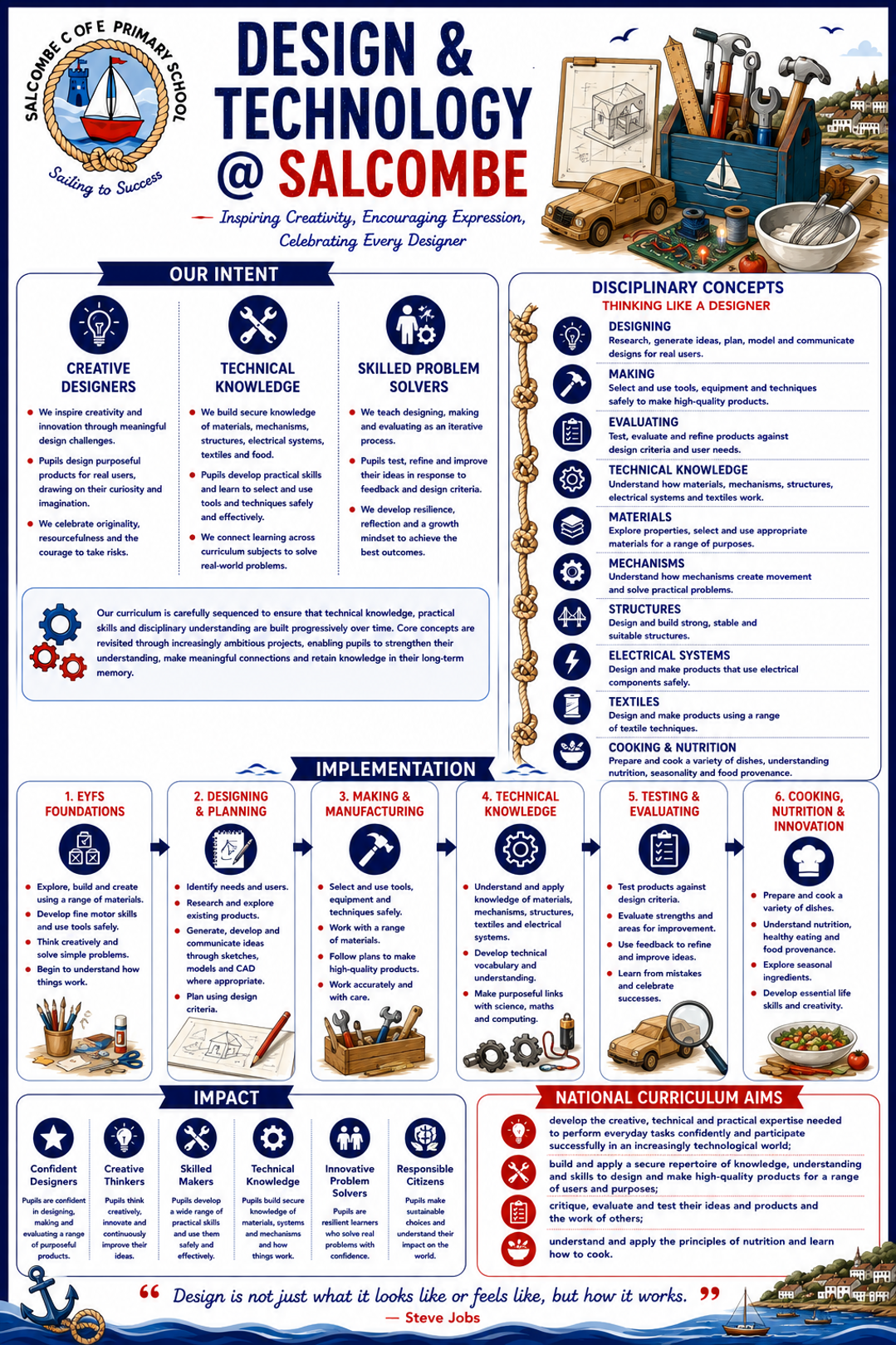
At Salcombe CE Primary School, our intent is to develop all pupils into creative, resilient and innovative designers who understand how Design and Technology shapes the world around them. In alignment with the National Curriculum, our Design and Technology curriculum is underpinned by the understanding that DT is an inspiring, rigorous and practical subject which combines creativity with technical knowledge to solve real-world problems. Through carefully sequenced learning, pupils develop both substantive knowledge (knowing about materials, mechanisms, structures, food, textiles and electrical systems) and disciplinary knowledge (thinking and working as designers, makers and evaluators), enabling them to become confident problem-solvers who can design purposeful products for real users.
Our bespoke Design and Technology curriculum has been carefully designed to meet
the needs of our pupils. Wherever possible, children design and make products linked to meaningful contexts, drawing inspiration from their local environment, school community and wider curriculum. Through authentic design challenges, pupils learn that successful products are created by understanding users' needs, exploring ideas creatively and refining solutions through an iterative process of design, making and evaluation.
Our curriculum is built around the key concepts of designing, making, evaluating, technical knowledge and cooking and nutrition. These concepts are revisited throughout pupils' primary education, enabling children to deepen their understanding whilst developing increasingly sophisticated practical skills and technical knowledge. Through repeated opportunities to investigate, create, test and improve products, pupils learn that mistakes are an essential part of the design process and that resilience, reflection and innovation lead to successful outcomes.
We intend for pupils to:
- develop creative, technical and practical expertise needed to perform everyday tasks confidently and participate successfully in an increasingly technological world;
- build and apply a secure repertoire of knowledge, understanding and skills to design and make high-quality products for a range of users and purposes;
- develop confidence in designing, modelling, making and evaluating products through an iterative design process;
- understand the properties of materials and select appropriate tools, equipment and techniques safely and effectively;
- communicate ideas through discussion, annotated sketches, prototypes and, where appropriate, computer-aided design (CAD);
- develop resilience by testing, evaluating and refining products in response to feedback and design criteria;
- understand mechanisms, structures, textiles, electrical systems and food technology through progressively challenging practical projects;
- develop an understanding of healthy eating, nutrition, seasonality and food provenance through practical cooking experiences;
- appreciate the work and influence of designers, engineers, inventors, chefs and manufacturers who have shaped the modern world;
- become creative, resourceful and reflective learners who are equipped to solve practical problems in an ever-changing world.
Our curriculum has been carefully sequenced to ensure that technical knowledge, practical skills and disciplinary understanding are built progressively over time. Core concepts are deliberately revisited through increasingly ambitious projects, enabling pupils to strengthen their understanding, make meaningful connections and retain knowledge in their long-term memory. We recognise that children learn Design and Technology most effectively through purposeful practical experiences where new learning is explicitly connected to prior knowledge and applied within meaningful contexts.
We intend to provide:
- ambitious design-and-make projects centred around meaningful real-life contexts;
- explicit teaching of designing, making and evaluating as an iterative process;
- opportunities to work with a broad range of materials, tools and technologies;
- carefully sequenced progression in practical skills, technical knowledge and vocabulary;
- purposeful links with science, mathematics, computing and art;
- regular opportunities to investigate existing products and evaluate their effectiveness;
- practical cooking experiences that develop healthy lifestyles and essential life skills;
- adaptive teaching that enables every pupil to achieve success as a designer and maker.
Ultimately, we aim to ensure that every child leaves Salcombe CE Primary School with the creativity, confidence and practical capability to solve problems, innovate and contribute positively to an increasingly technological society. We aspire for our pupils to become resilient learners who recognise that great design is driven by curiosity, collaboration, reflection and continual improvement.
At Salcombe, our Design and Technology curriculum follows the objectives of the National Curriculum as a minimum. The aims of teaching Design and Technology, as outlined in the National Curriculum, are to ensure that all pupils:
- develop the creative, technical and practical expertise needed to perform everyday tasks confidently and participate successfully in an increasingly technological world;
- build and apply a repertoire of knowledge, understanding and skills in order to design and make high-quality prototypes and products for a wide range of users;
- critique, evaluate and test their ideas and products, and the work of others;
- understand and apply the principles of nutrition and learn how to cook.
In the Early Years, children begin developing their design and technology understanding through the Expressive Arts and Design and Physical Development areas of learning. They safely explore a wide variety of materials, tools and techniques, learning how to design, make and talk about the products they create. Through purposeful play and carefully planned adult-led experiences, children develop early cutting, joining, constructing and cooking skills whilst learning to communicate their ideas and reflect on the process they have followed. These experiences lay the foundations for future design thinking by nurturing creativity, curiosity, resilience and problem-solving.
As pupils move into Key Stage One, learning builds upon these foundations through carefully sequenced units covering food technology, textiles, structures and mechanisms. Pupils begin designing for specific users and purposes, exploring existing products before generating and communicating their own ideas through drawings, discussion and simple prototypes. Teachers explicitly introduce technical vocabulary, model practical techniques and teach children how to safely select and use an increasing range of tools, equipment and materials. Through practical experiences, pupils begin to understand how products are designed to solve problems and meet the needs of users.
Throughout Key Stage Two, pupils revisit and deepen their understanding of Design and Technology through increasingly ambitious projects involving textiles, food, structures, mechanical systems and electrical systems. Learning is carefully sequenced to build pupils' substantive knowledge whilst explicitly developing disciplinary knowledge through the iterative process of investigating, designing, making and evaluating. As pupils progress, they produce annotated sketches, prototypes and computer-aided designs (CAD), select materials according to their functional and aesthetic properties, and apply increasingly accurate practical skills to manufacture high-quality products.
Each unit is driven by a meaningful design brief that requires pupils to solve a practical problem for an intended user and purpose. Teachers explicitly model the design process, enabling pupils to research, generate ideas, test prototypes, evaluate existing products and refine their work in response to feedback. Pupils are encouraged to justify their design decisions using technical vocabulary whilst developing resilience through recognising that evaluation and improvement are fundamental parts of successful design.
Practical learning lies at the heart of our curriculum. Pupils progressively develop confidence in using a wide range of tools, equipment, materials and technologies safely and accurately. Cooking and nutrition units provide valuable opportunities for children to prepare, cook and evaluate food whilst developing an understanding of healthy eating, seasonality, food provenance and nutrition. Cross-curricular links with science, mathematics and computing enable pupils to apply their learning in authentic and meaningful contexts.
Vocabulary is explicitly planned and systematically revisited throughout every unit. Retrieval practice is embedded within lessons, enabling pupils to strengthen long-term memory and make meaningful connections between previous and current learning. Oracy plays an important role within DT, with pupils regularly discussing design ideas, explaining technical processes, evaluating products and presenting solutions using ambitious subject-specific language.
Adaptive teaching ensures all pupils access ambitious Design and Technology learning. Teachers use modelling, scaffolding, visual supports, carefully selected resources and targeted questioning to support understanding whilst maintaining high expectations for every learner. Opportunities for challenge enable pupils to become increasingly independent designers who confidently justify decisions, solve complex problems and refine their products through thoughtful evaluation.
Impact
Teachers use a range of formative and summative assessment strategies to assess pupils' technical knowledge, practical skills and disciplinary understanding throughout each unit. Observation, questioning, discussion, retrieval practice and evaluation activities enable teachers to identify misconceptions and adapt teaching responsively. Practical outcomes are assessed alongside the thinking, decision-making and problem-solving demonstrated throughout the design process, ensuring that assessment reflects both the journey and the final product.
At the end of each unit, pupils complete a purposeful design outcome that enables them to demonstrate both their substantive knowledge and their ability to apply the iterative design process. Teachers assess pupils' understanding against National Curriculum expectations and use this information to inform future planning, support and challenge.
As pupils progress through the curriculum, they develop increasingly secure technical knowledge alongside the confidence to investigate problems, communicate ideas creatively, manufacture products accurately and evaluate their effectiveness critically. They become increasingly resourceful when selecting tools, materials and techniques and demonstrate resilience by refining and improving their work in response to testing and feedback.
Regular retrieval practice, revisiting of core concepts and carefully sequenced progression ensure that pupils know more, remember more and make increasingly sophisticated connections across the Design and Technology curriculum. Professional dialogue and moderation support consistency in assessment and contribute to the continual refinement of curriculum provision.
The impact of our curriculum is evident in pupils who approach design challenges with confidence, creativity and determination. They think critically, communicate effectively and apply technical knowledge to solve practical problems. They understand how designers, engineers, inventors and chefs have shaped the modern world and recognise the importance of innovation, sustainability and thoughtful design.
By embedding our Christian ethos and values, when pupils leave Salcombe CE Primary School, they possess a secure understanding of the design process, practical skills across a broad range of disciplines and the confidence to apply their knowledge creatively in unfamiliar contexts. They leave equipped not only for the next stage of their education but also as resilient, innovative and responsible citizens who are prepared to contribute positively to an increasingly technological world.