Salcombe C of E
Primary School
Geography @ Salcombe Church of England
Intent
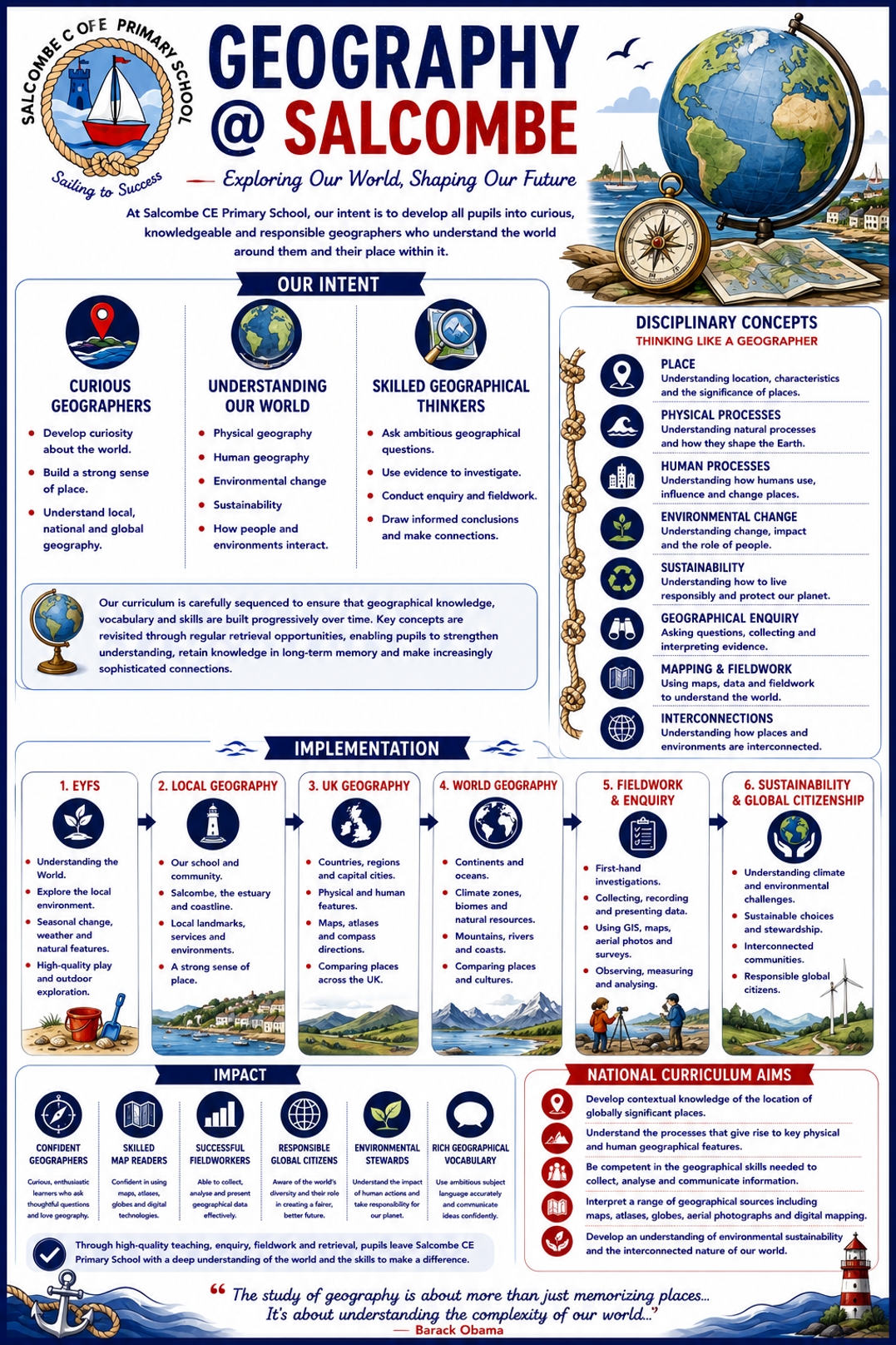
At Salcombe CE Primary School, our intent is to develop all pupils into curious, knowledgeable and responsible geographers who understand the world around them and their place within it. In alignment with the National Curriculum, our geography curriculum is underpinned by the understanding that geography is the study of people, places and environments, and the dynamic relationships between them. Through carefully sequenced learning, pupils develop both substantive knowledge (knowing about places, environments and processes) and disciplinary knowledge (thinking and working as geographers), enabling them to make sense of an ever-changing world.
Our bespoke geography curriculum has been carefully designed to reflect both our unique coastal setting and the needs of our pupils. Nestled along the stunning South Devon coastline, Salcombe provides a rich and meaningful context in which children can experience geography first-hand. Our curriculum begins with the geography that pupils know best—our school, local community, estuary, coastline and surrounding countryside—before progressively broadening their understanding to encompass the United Kingdom and the wider world. Through this approach, pupils develop a strong sense of place whilst recognising the interconnected nature of people, places and environments across the globe.
Our curriculum is built around the key geographical concepts of place, physical processes, human processes, environmental change and sustainability. These concepts are revisited throughout pupils' primary education, enabling them to deepen their understanding and make increasingly sophisticated connections between their learning. Through these themes, pupils compare locations, environments and cultures, recognising how places are both unique and interconnected. They develop an understanding of how physical geography influences human activity and how human decisions continue to shape the environment.
We intend for pupils to:
- develop secure knowledge of the world's continents, oceans, countries and significant regions;
- understand the physical and human processes that shape places and environments;
- develop a strong sense of place through meaningful study of their local area before expanding their knowledge nationally and globally;
- investigate geographical questions through observation, enquiry and fieldwork;
- confidently use maps, atlases, globes, aerial photographs and digital mapping technologies;
- collect, interpret and present geographical data using a range of appropriate methods;
- develop ambitious geographical vocabulary and communicate their understanding with increasing confidence;
- understand environmental issues and appreciate the importance of sustainable development;
- recognise the interconnected nature of communities and environments across the world;
- become curious, informed and responsible global citizens.
Our curriculum has been carefully sequenced to ensure that geographical knowledge, vocabulary and disciplinary skills are built progressively over time. Core geographical concepts are deliberately revisited through carefully planned retrieval opportunities, enabling pupils to strengthen their understanding and retain knowledge in their long-term memory. We recognise that children learn geography most effectively when new learning is explicitly connected to prior knowledge and when they have opportunities to apply their understanding in meaningful contexts.
We intend to provide:
- high-quality geographical enquiries centred around ambitious questions;
- regular opportunities for fieldwork and first-hand geographical investigation;
- explicit teaching of geographical vocabulary and disciplinary knowledge;
- meaningful use of maps, atlases, globes and geographical information systems (GIS);
- opportunities to compare places and environments at local, national and global scales;
- adaptive teaching that ensures all pupils achieve success as geographers.
Ultimately, we aim to ensure that every child leaves Salcombe CE Primary School with a secure understanding of the world, an appreciation of its diversity and complexity, and the confidence to apply their geographical knowledge to the challenges of the future. We aspire for our pupils to become thoughtful stewards of the environment who understand that their choices can make a positive difference both locally and globally.
At Salcombe, our geography curriculum follows the objectives of the National Curriculum as a minimum. The aims of teaching geography, as outlined in the National Curriculum, are to ensure that all pupils:
- develop contextual knowledge of the location of globally significant places;
- understand the processes that give rise to key physical and human geographical features;
- are competent in the geographical skills needed to collect, analyse and communicate geographical information;
- interpret a range of geographical sources including maps, atlases, globes, aerial photographs and digital mapping;
- develop an understanding of environmental sustainability and the interconnected nature of our world.
Implementation
In the Early Years, children begin developing geographical understanding through the ‘Understanding the World’ area of learning. They explore their immediate environment through high-quality continuous provision, outdoor learning and purposeful play. Children observe seasonal change, weather, natural features and the environments around them, developing early geographical language through meaningful experiences. Adults encourage children to compare places, talk about journeys, recognise familiar landmarks and begin to understand similarities and differences between their own lives and those of others. These experiences lay the foundations for future geographical thinking by nurturing curiosity, observation and a sense of place.
As pupils move into Key Stage One, learning builds upon these foundations through carefully sequenced units that begin with the familiar before extending into the wider world. Pupils develop knowledge of their local area, the United Kingdom and contrasting locations beyond Europe, making meaningful comparisons between different environments and communities. Teachers explicitly introduce key geographical concepts, including physical and human features, weather, climate and simple mapping skills. Pupils learn to interpret maps, aerial photographs and atlases whilst beginning to use geographical vocabulary accurately during discussion and written work.
Throughout Key Stage Two, pupils revisit and deepen their understanding of geographical concepts through increasingly sophisticated enquiries. Learning explores continents, countries and regions alongside themes such as rivers, mountains, coasts, climate zones, biomes, natural resources, trade, settlements, population and environmental change. Units are carefully sequenced to build pupils' substantive knowledge whilst explicitly developing disciplinary knowledge through geographical enquiry and investigation.
Each unit within the curriculum is driven by a meaningful geographical question that encourages pupils to investigate, reason and draw informed conclusions. Teachers explicitly model geographical thinking, enabling pupils to ask perceptive questions, interpret evidence, identify patterns and explain relationships between physical and human geography. Pupils are encouraged to justify their thinking using geographical vocabulary and evidence gathered through fieldwork, maps and secondary sources.
Fieldwork is fundamental to geographical learning at Salcombe. Our exceptional coastal location provides regular opportunities for first-hand investigation of coasts, rivers, settlements and tourism. Pupils progressively develop practical geographical skills by observing, measuring, recording and presenting data through maps, sketches, photographs, surveys and digital technologies. Fieldwork enables children to apply classroom learning in authentic contexts whilst developing a deep appreciation of their local environment.
Vocabulary is explicitly planned and systematically revisited throughout every unit. Retrieval practice is embedded within lessons, enabling pupils to strengthen long-term memory and make meaningful connections between previous and current learning. Oracy plays an important role in geography, with pupils regularly discussing geographical issues, presenting findings, debating environmental challenges and explaining their thinking using ambitious subject-specific language.
Adaptive teaching ensures all pupils access ambitious geographical learning. Teachers use modelling, scaffolding, carefully chosen resources and targeted questioning to support understanding whilst maintaining high expectations for all learners. Opportunities for challenge are carefully planned, allowing pupils to undertake increasingly independent enquiry, analyse complex geographical information and draw reasoned conclusions from a range of evidence.
Impact
Teachers use a range of formative and summative assessment strategies to assess pupils' geographical knowledge, understanding and disciplinary thinking. Throughout lessons, retrieval practice, questioning, discussion, fieldwork and enquiry tasks enable teachers to identify misconceptions and adapt teaching responsively. Adults continually assess pupils' understanding through observation, dialogue and carefully designed learning activities, ensuring that all children make strong progress through the curriculum.
At the end of each unit, pupils complete an independent geographical outcome that enables them to demonstrate both their substantive knowledge and disciplinary understanding linked to the unit's overarching enquiry question. Teachers use these outcomes to assess pupils' understanding against the National Curriculum expectations and to inform future planning and next steps in learning.
As pupils progress through the curriculum, they develop increasingly secure knowledge of places, environments and geographical processes. They become confident in interpreting maps, analysing geographical information, recognising patterns and explaining the relationships between physical and human geography. Their growing understanding enables them to make thoughtful comparisons between places and appreciate how local actions can have global consequences.
Regular retrieval practice, revisiting of key concepts and opportunities to apply learning ensure that pupils know more, remember more and make increasingly sophisticated connections across the geography curriculum. Professional dialogue and moderation support consistency in teacher assessment and contribute to the continual refinement of curriculum provision.
The impact of our curriculum is evident in pupils who are enthusiastic geographers, ask thoughtful questions and confidently communicate their understanding using accurate geographical vocabulary. They demonstrate curiosity about the world, appreciate the diversity of people and places and understand the importance of protecting the environments on which we all depend.
By the time pupils leave Salcombe CE Primary School, they possess a rich body of geographical knowledge, secure fieldwork and mapping skills and a deep understanding of the interconnected nature of our world. They leave equipped not only for the next stage of their education but also as compassionate, informed and responsible global citizens who are ready to contribute positively to both their local community and the wider world.