
Salcombe C of E
Primary School
Computing @ Salcombe CE Primary School
Intent
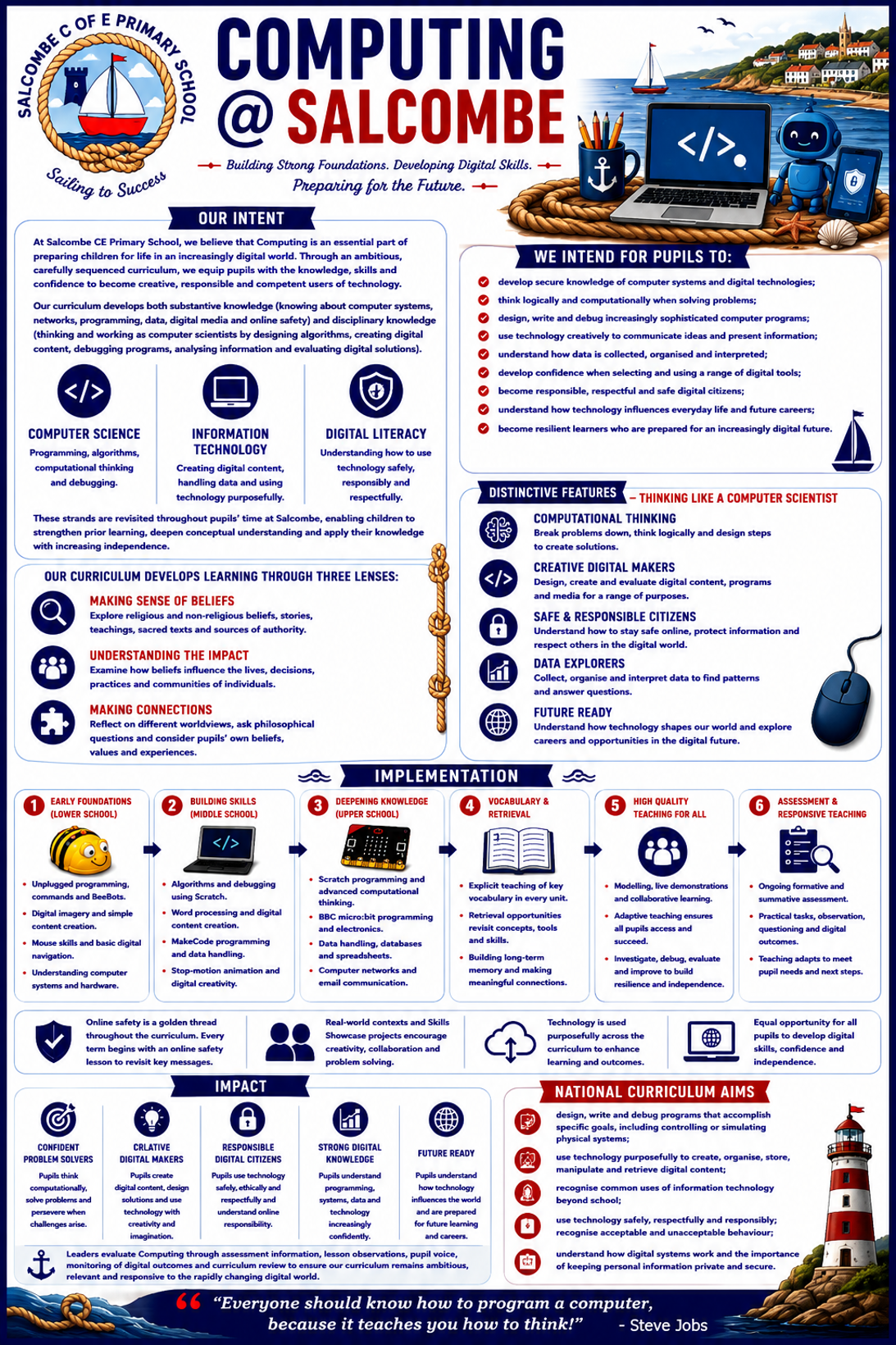
At Salcombe CE Primary School, we believe that Computing is an essential part of preparing children for life in an increasingly digital world. Through an ambitious, carefully sequenced curriculum, we equip pupils with the knowledge, skills and confidence to become creative, responsible and competent users of technology. We aim to develop children who not only understand how digital technology works but are also able to think computationally, solve problems creatively and use technology safely, responsibly and effectively throughout their lives.
Serving a rural coastal community in South Devon, we recognise that pupils have varying experiences of technology beyond school. Our curriculum ensures that every child, regardless of their starting point, develops the digital knowledge and skills needed to thrive in modern society. We provide meaningful opportunities for pupils to become digitally literate whilst encouraging curiosity, creativity, resilience and independence through the purposeful use of technology.
Our curriculum develops both substantive knowledge (knowing about computer systems, networks, programming, data, digital media and online safety) and disciplinary knowledge (thinking and working as computer scientists by designing algorithms, creating digital content, debugging programs, analysing information and evaluating digital solutions). Through carefully sequenced learning, pupils progressively develop confidence across all aspects of computing whilst understanding how technology shapes the world around them.
Our curriculum is built around the three key strands of the National Curriculum:
- Computer Science – programming, algorithms, computational thinking and debugging.
- Information Technology – creating digital content, handling data and using technology purposefully.
- Digital Literacy – understanding how to use technology safely, responsibly and respectfully.
These strands are revisited throughout pupils' time at Salcombe, enabling children to strengthen prior learning, deepen conceptual understanding and apply their knowledge with increasing independence.
We intend for pupils to:
- develop secure knowledge of computer systems and digital technologies;
- think logically and computationally when solving problems;
- design, write and debug increasingly sophisticated computer programs;
- use technology creatively to communicate ideas and present information;
- understand how data is collected, organised and interpreted;
- develop confidence when selecting and using a range of digital tools;
- become responsible, respectful and safe digital citizens;
- understand how technology influences everyday life and future careers;
- become resilient learners who are prepared for an increasingly digital future.
Our curriculum has been carefully sequenced to ensure that pupils build secure foundations before progressing towards increasingly sophisticated digital skills. Children begin by exploring simple programming through unplugged activities, commands and BeeBots before progressing to Scratch programming, MakeCode, BBC micro:bit programming and increasingly complex computational thinking. Alongside programming, pupils develop progressively deeper understanding of computer systems, networks, digital media and data handling through meaningful and engaging contexts.
Ultimately, we aim for every child to leave Salcombe CE Primary School with the knowledge, skills and confidence to participate successfully in an increasingly digital society. We aspire for our pupils to become creative problem solvers, responsible digital citizens and confident users of technology who understand both its possibilities and responsibilities.
Implementation
Computing is taught through a carefully sequenced curriculum based upon the Kapow Primary scheme, ensuring full National Curriculum coverage whilst providing clear progression in knowledge, skills and vocabulary across all year groups. Learning is organised through the three interconnected strands of Computer Science, Information Technology and Digital Literacy, enabling pupils to develop increasingly sophisticated understanding as they move through the school.
Online safety is a golden thread throughout the curriculum. Every new term begins with an online safety lesson, enabling pupils to revisit key safeguarding messages, explore current online issues and develop increasingly mature understanding of responsible digital behaviour. This regular retrieval ensures that online safety remains relevant and responsive to children's experiences.
In the Lower School, pupils begin by developing early computational thinking through unplugged programming, commands and BeeBots before exploring digital imagery, simple data handling and improving their understanding of computer systems through mouse skills and basic digital navigation.
As pupils progress into the Middle School, they deepen their understanding of algorithms, debugging, word processing, MakeCode programming and data handling whilst developing increasing independence when using digital technologies. Stop-motion animation introduces pupils to digital creativity and media production whilst strengthening links between computing and wider curriculum learning.
In the Upper School, pupils apply increasingly sophisticated computational thinking through Scratch programming, BBC micro:bit programming, computer networks, databases, email communication and digital media. Skills Showcase projects provide opportunities for pupils to combine multiple computing disciplines within purposeful contexts, encouraging creativity, collaboration and problem solving.
Vocabulary is explicitly taught throughout every unit, enabling pupils to use increasingly precise computing terminology when discussing systems, algorithms, debugging, networks, databases and programming. Retrieval opportunities are carefully planned to revisit key concepts, vocabulary and programming skills, strengthening long-term memory and enabling pupils to make meaningful connections across different areas of computing.
Teachers use modelling, live demonstrations, collaborative problem solving and adaptive teaching strategies to ensure that every pupil can participate successfully regardless of prior experience. Pupils are encouraged to investigate, debug, evaluate and improve their work, developing resilience, independence and confidence as computational thinkers.
Impact
Teachers use a range of formative and summative assessment strategies to assess pupils' substantive knowledge, computational thinking and practical computing skills throughout each unit of learning. Observation, questioning, practical programming tasks, digital outcomes and pupil discussion enable teachers to identify misconceptions and adapt teaching responsively.
As pupils progress through the curriculum, they develop increasingly secure understanding of programming, digital systems, data handling and online safety. They become increasingly confident in creating digital content, solving problems through computational thinking and selecting appropriate digital tools for different purposes.
Regular retrieval opportunities ensure that pupils strengthen their understanding of key concepts, vocabulary and programming techniques over time. Through carefully sequenced learning, they make increasingly sophisticated connections between programming, digital creativity, information technology and responsible digital citizenship.
The impact of our curriculum is evident in pupils who approach computing with confidence, curiosity and resilience. They demonstrate creativity when designing digital solutions, perseverance when debugging programs and responsibility when using technology. Pupils understand how technology can be used safely, ethically and purposefully whilst recognising its role within everyday life and future careers.
Leaders evaluate the effectiveness of Computing through assessment information, lesson observations, pupil voice, monitoring of digital outcomes and ongoing curriculum review. This continual evaluation ensures that the curriculum remains ambitious, relevant and responsive to the rapidly changing digital world.
By embedding our Christian values and ethos, when pupils leave Salcombe CE Primary School, they have developed secure computational thinking, confidence in programming and a broad understanding of digital technology. They are responsible digital citizens who understand how to use technology safely, creatively and effectively. Equipped with secure knowledge, practical skills and digital resilience, they leave well prepared for the next stage of their education and for life in an increasingly connected world.