Salcombe C of E
Primary School
Early Reading

Early Reading @ Salcombe
Intent
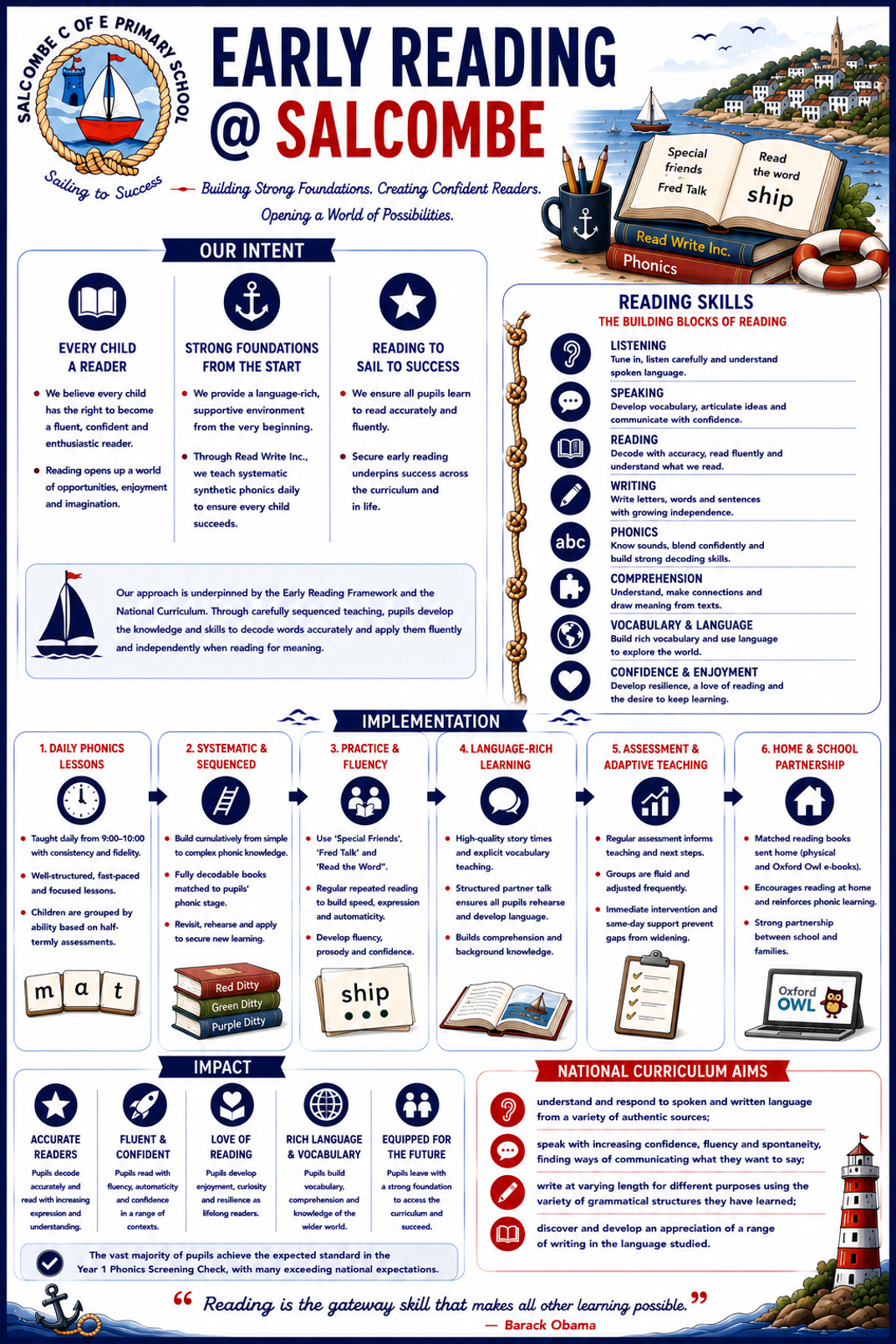
At Salcombe CE Primary School, we believe that reading is the gateway to learning and that every child has the right to become a fluent, confident and enthusiastic reader. We recognise the value of being able to read with fluency and confidence. It supports children to be successful in all areas of their lives opening up a world of opportunities for new vocabulary, enjoyment of reading and firing their imagination to inspire writing.
Early reading is at the heart of our curriculum and is prioritised to ensure all pupils become fluent, confident readers. Serving a rural coastal community in Devon, we recognise that pupils may have varied starting points and differing levels of exposure to language and literature. Therefore, we are committed to providing a language-rich learning environment from the very beginning of a child's educational journey, developing both pupils' oral language skills and phonological awareness. When children join our Reception Class, we ensure that every pupil succeeds through a highly structured approach to early reading implemented through our DfE-approved systematic synthetic phonics programme, Read Write Inc.
Our intent is that all pupils will learn to read accurately and fluently to support each child to sail to success. We understand that secure early reading is essential for accessing the full curriculum and for future educational success. Our approach is underpinned by the Early Reading Framework and the National Curriculum, with a clear emphasis on systematic synthetic phonics as the most effective route to early reading. Through carefully sequenced teaching, pupils develop both the substantive knowledge required to decode words accurately and the disciplinary knowledge needed to apply these skills fluently, confidently and independently when reading for meaning.
Implementation
Phonics is taught daily with consistency and fidelity from 9:00am until 10:00am. Lessons are well-structured, fast-paced and focused, enabling pupils to secure new knowledge and apply it effectively. All children are grouped according to ability. These groupings are informed by half-termly assessments which evaluate pupils' secure knowledge of sounds, their ability to decode both real and pseudo (alien) words, and their developing reading fluency. At Salcombe, we subscribe to the Ruth Miskin Portal, providing access to high-quality planning, assessment materials, professional development and coaching to ensure fidelity to the programme and consistency of delivery.
Additionally, we ensure that the implementation of early reading is both rigorous and inclusive, beginning with a strong foundation in consistent, high-quality teaching. Staff are trained in Read Write Inc. (RWI) and deliver daily phonics sessions using agreed routines, precise modelling, and clear articulation of phonemes. Weekly coaching sessions and team meetings enable staff to practise and refine their delivery, ensuring fidelity and consistency across the school, which is fundamental to securing strong outcomes for every pupil. Within teaching groups, we insist that all children use 'Special Friends', 'Fred Talk' and 'Read the Word' to develop secure decoding strategies and independence.
This strong teaching foundation is underpinned by a systematic and carefully sequenced approach. Pupils follow a structured programme that builds cumulatively from simple to more complex phonic knowledge, ensuring new learning is secure before moving on. Reading materials are closely matched to pupils' developing phonic knowledge through fully decodable texts, enabling pupils to practise and consolidate newly taught sounds while building confidence and independence. These books are not only used in school but are also carefully matched for home reading through both physical reading books and Oxford Owl e-books, strengthening the partnership between school and home whilst providing additional opportunities for repeated reading and practice.
As pupils progress, the focus extends beyond accuracy to developing fluency, prosody and automaticity. Regular opportunities for repeated reading enable pupils to read with increasing speed, expression and understanding. Alongside this, we place a strong emphasis on language development. Recognising that some pupils may have limited exposure to a broad vocabulary, we prioritise high-quality story time, explicit vocabulary teaching and rich classroom talk, with structured partner talk ensuring all pupils are actively engaged in rehearsing and developing language. These carefully planned opportunities enable pupils to strengthen their comprehension, develop confidence as communicators and build the background knowledge required for future reading success.
Assessment is integral to our approach and ensures that teaching remains responsive to pupils' needs. Pupils are assessed regularly and grouped according to their stage of phonics development, with groups remaining fluid and adjusted frequently to maintain a close match between teaching and pupils' current attainment, allowing gaps to be identified and addressed swiftly. Assessment information is used diagnostically to inform next steps in teaching and ensure that every pupil receives the precise support required to make strong progress.
Finally, we prioritise a 'keep up, not catch up' approach to ensure that no pupil falls behind. Immediate intervention is provided for those who need additional support, including same-day one-to-one teaching where necessary, preventing gaps from widening and enabling all pupils to keep pace with the programme. Adaptive teaching, targeted interventions and ongoing assessment ensure that every child has the opportunity to become a successful reader regardless of their starting point.
Teachers use a range of formative and summative assessment strategies to assess pupils' phonic knowledge, decoding skills, fluency and reading accuracy throughout the Read Write Inc. programme. Ongoing assessment, half-termly Read Write Inc. assessments, daily observations and responsive questioning enable teachers to identify misconceptions quickly and adapt teaching accordingly. Assessment information from the Ruth Miskin Portal is used diagnostically to inform teaching groups, targeted interventions and next steps, ensuring that every pupil receives precisely the support they need to make strong progress.
As pupils move through the programme, they develop increasingly secure phonic knowledge alongside growing confidence and automaticity in decoding unfamiliar words. Through regular opportunities for repeated reading, pupils become increasingly fluent readers who read with accuracy, expression and understanding. The carefully sequenced nature of the programme ensures that pupils build secure foundations before progressing to more complex phonic knowledge, enabling them to access the wider curriculum with confidence.
Our commitment to a 'keep up, not catch up' approach ensures that gaps in learning are identified and addressed immediately. Same-day interventions, targeted afternoon support and Speech Link programmes provide timely intervention where required, preventing pupils from falling behind and enabling them to continue making strong progress alongside their peers. Leaders continually monitor the quality of provision through coaching, lesson observations, assessment analysis and pupil voice, ensuring fidelity to the programme and consistency of teaching across the school.
Impact:
The impact of our approach is evident in pupils who read accurately, fluently and with increasing confidence. They demonstrate resilience when tackling unfamiliar vocabulary, apply their phonic knowledge independently and develop a genuine enthusiasm for reading. High-quality story times and explicit vocabulary instruction broaden pupils' language, strengthen comprehension and deepen their understanding of the wider world beyond their rural coastal community.
Regular monitoring, professional dialogue and ongoing evaluation ensure that our early reading provision continues to evolve in response to pupils' needs while maintaining the highest standards of teaching. As a result, the vast majority of pupils achieve the expected standard in the Year 1 Phonics Screening Check, with many exceeding national expectations.
By the time pupils leave the Read Write Inc. programme, they have developed the knowledge, fluency and confidence to read independently and successfully access the wider curriculum. They leave the early stages of reading as enthusiastic, capable readers with a secure foundation for lifelong learning, prepared not only for the next stage of their education but also with a genuine love of reading that will enrich their lives beyond the classroom.